Ch. 28 - Protists
Campbell - Campbell Biology 11th Edition
Urry11th EditionCampbell BiologyISBN: 9789357423311당신이 사용하는 게 아니라요?교과서 변경
28장, 문제 6

Based on the phylogenetic tree in Figure 28.2, which of the following statements is correct?
a. The most recent common ancestor of Excavata is older than that of SAR.
b. The most recent common ancestor of SAR is older than that of Unikonta.
c. The most basal (first to diverge) eukaryotic supergroup cannot be determined.
d. Excavata is the most basal eukaryotic supergroup.

검증된 단계별 안내
1
Understand the concept of a phylogenetic tree: A phylogenetic tree is a diagram that represents evolutionary relationships among various biological species based upon similarities and differences in their physical or genetic characteristics.
Identify the key terms: 'Most recent common ancestor' refers to the last shared ancestor between two groups. 'Basal' refers to the earliest diverging lineage in a phylogenetic tree.
Examine the phylogenetic tree in Figure 28.2: Look for the branching points that indicate common ancestors and note the order of divergence among the eukaryotic supergroups.
Compare the branching points: Determine which supergroup has the oldest common ancestor by comparing the positions of the branching points for Excavata, SAR, and Unikonta.
Assess the basal lineage: Evaluate the tree to see if there is a clear indication of which eukaryotic supergroup diverged first, or if the tree does not provide enough information to determine the most basal group.

비슷한 문제에 대한 검증된 영상 답변:

이 영상 해법은 위 문제에 도움이 된다고 튜터들이 추천한 것입니다.
영상 길이:
3m

주요 개념

질문에 올바르게 답하기 위해 반드시 이해해야 하는 핵심 개념들은 다음과 같습니다.

Phylogenetic Tree

A phylogenetic tree is a diagram that represents evolutionary relationships among various biological species based on similarities and differences in their physical or genetic characteristics. It shows how species are related through common ancestors, with branches indicating divergence points. Understanding the tree's structure is crucial for interpreting evolutionary timelines and ancestral connections.
추천 영상:
가이드 코스
04:13
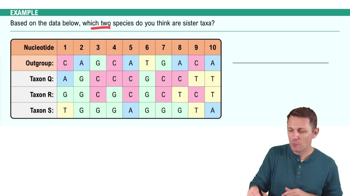
Building Phylogenetic Trees Example 2

Eukaryotic Supergroups

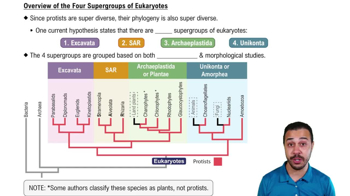
Eukaryotic supergroups are major classifications within the domain Eukarya, which includes organisms with complex cells containing a nucleus. The main supergroups are Excavata, SAR (Stramenopiles, Alveolates, and Rhizaria), Archaeplastida, and Unikonta. Each supergroup represents a distinct lineage, and understanding their evolutionary relationships helps in determining the order of divergence among them.
추천 영상:
03:01
Overview of the Four Supergroups of Eukaryotes

Most Recent Common Ancestor

The most recent common ancestor (MRCA) refers to the last shared ancestor between two or more species or groups before they diverged into separate lineages. In phylogenetic analysis, identifying the MRCA helps in understanding the evolutionary timeline and the relative age of different groups. It is a key concept for determining which group diverged first or which ancestor is older.
추천 영상:
가이드 코스
06:39
Common Misconceptions
관련 실천
교과서 질문

Which group is incorrectly paired with its description?

a. Diatoms—important producers in aquatic communities

b. Red algae—eukaryotes that acquired plastids by secondary endosymbiosis

c. Apicomplexans—unicellular parasites with intricate life cycles

d. Diplomonads—unicellular eukaryotes with modified mitochondria

1263
views
교과서 질문

According to the phylogeny, which protists are in the same eukaryotic supergroup as plants?

a. Green algae

b. Dinoflagellates

c. Red algae

d. Both A and C

824
views
교과서 질문

In a life cycle with alternation of generations, multicellular haploid forms alternate with

a. Unicellular haploid forms

b. Unicellular diploid forms

c. Multicellular haploid forms

d. Multicellular diploid forms

1174
views
교과서 질문

Medical researchers seek to develop drugs that can kill or restrict the growth of human pathogens yet have few harmful effects on patients. These drugs often work by disrupting the metabolism of the pathogen or by targeting its structural features.

Draw and label a phylogenetic tree that includes an ancestral prokaryote and the following groups of organisms: Excavata, SAR, Archaeplastida, Unikonta, and, within Unikonta, amoebozoans, animals, choanoflagellates, fungi, and nucleariids. Based on this tree, hypothesize whether it would be most difficult to develop drugs to combat human pathogens that are prokaryotes, protists, animals, or fungi. (You do not need to consider the evolution of drug resistance by the pathogen.)
1505
views
2
rank