Ch. 28 - Protists
Campbell - Campbell Biology 11th Edition
Urry11th EditionCampbell BiologyISBN: 9789357423311당신이 사용하는 게 아니라요?교과서 변경
28장, 문제 3

Which group is incorrectly paired with its description?
a. Diatoms—important producers in aquatic communities
b. Red algae—eukaryotes that acquired plastids by secondary endosymbiosis
c. Apicomplexans—unicellular parasites with intricate life cycles
d. Diplomonads—unicellular eukaryotes with modified mitochondria

검증된 단계별 안내
1
Step 1: Begin by understanding the characteristics of each group mentioned in the options. Diatoms are a type of algae known for their silica cell walls and are indeed important producers in aquatic ecosystems.
Step 2: Examine red algae. They are eukaryotic organisms that contain plastids, but these plastids were acquired through primary endosymbiosis, not secondary endosymbiosis. This is a key point to consider.
Step 3: Consider apicomplexans. These are unicellular parasites, such as Plasmodium, which have complex life cycles often involving multiple hosts. This description is accurate.
Step 4: Look at diplomonads. These are unicellular eukaryotes, such as Giardia, that have modified mitochondria known as mitosomes. This description is correct.
Step 5: Compare each description with the known characteristics of the groups. Identify the group whose description does not match its known biological features, focusing on the distinction between primary and secondary endosymbiosis in red algae.

비슷한 문제에 대한 검증된 영상 답변:

이 영상 해법은 위 문제에 도움이 된다고 튜터들이 추천한 것입니다.
영상 길이:
2m
도움이 되었나요?

주요 개념

질문에 올바르게 답하기 위해 반드시 이해해야 하는 핵심 개념들은 다음과 같습니다.

Diatoms

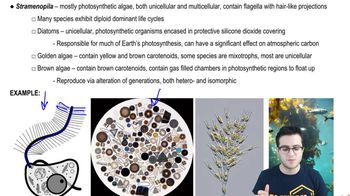
Diatoms are a major group of algae and are among the most common types of phytoplankton. They are important producers in aquatic communities, contributing significantly to the global carbon cycle through photosynthesis. Diatoms have silica cell walls, which give them a unique and intricate appearance under a microscope.
추천 영상:
10:24
Stramenopila and Alveolata

Secondary Endosymbiosis

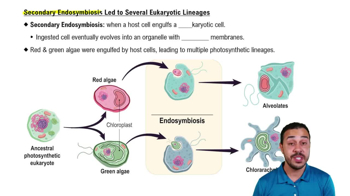
Secondary endosymbiosis refers to the process by which a eukaryotic cell engulfs another eukaryotic cell that has already undergone primary endosymbiosis. This process is believed to have led to the acquisition of plastids in certain algae, such as red algae, allowing them to perform photosynthesis. It is a key concept in understanding the evolution of complex cells.
추천 영상:
02:37
Secondary Endosymbiosis Led to Several Eukaryotic Lineages

Diplomonads

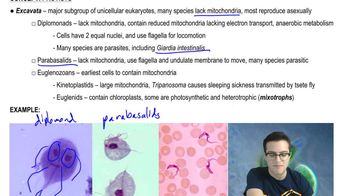
Diplomonads are a group of unicellular eukaryotes characterized by having modified mitochondria known as mitosomes, which lack the ability to perform oxidative phosphorylation. They are often parasitic, with Giardia lamblia being a well-known example that causes gastrointestinal infections in humans. Understanding their unique cellular structure is crucial for studying their biology and pathogenicity.
추천 영상:
05:57
Excavata and Archaeplastida (Plantae)