What type of information is used to direct different polypeptides to fold into different shapes?
Ch.3 - Protein Structure and Function
3장, 문제 1
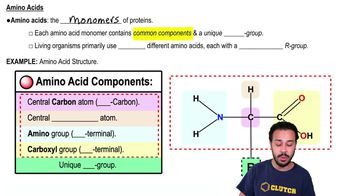
What two functional groups are bound to the central carbon of every free amino acid monomer?
a. an R-group and a hydroxyl group
b. an amino group and a hydroxyl group
c. an amino group and a carboxyl group
검증된 단계별 안내1
Identify the central carbon in an amino acid, which is also known as the alpha carbon.
Recognize that each amino acid has a specific side chain known as an R-group attached to the central carbon.
Understand that in addition to the R-group, there are two other groups attached to the central carbon: an amino group and a carboxyl group.
Recall that the amino group is characterized by the presence of nitrogen (typically NH2), and the carboxyl group contains a double-bonded oxygen and an OH group (COOH).
Conclude that the correct answer must include both an amino group and a carboxyl group attached to the central carbon of every free amino acid monomer.

비슷한 문제에 대한 검증된 영상 답변:
이 영상 해법은 위 문제에 도움이 된다고 튜터들이 추천한 것입니다.
영상 길이:
2m도움이 되었나요?
주요 개념
질문에 올바르게 답하기 위해 반드시 이해해야 하는 핵심 개념들은 다음과 같습니다.
Amino Acids
Amino acids are organic compounds that serve as the building blocks of proteins. Each amino acid consists of a central carbon atom (the alpha carbon) bonded to four different groups: an amino group, a carboxyl group, a hydrogen atom, and a variable R-group (side chain) that determines the specific properties of the amino acid.
추천 영상:
가이드 코스
Amino Acids
Functional Groups
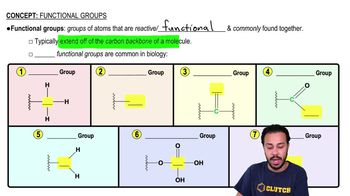
Functional groups are specific groups of atoms within molecules that are responsible for the characteristic chemical reactions of those molecules. In amino acids, the two key functional groups are the amino group (-NH2), which acts as a base, and the carboxyl group (-COOH), which acts as an acid, allowing amino acids to participate in various biochemical processes.
추천 영상:
가이드 코스
Functional Groups
Peptide Bond Formation
Peptide bonds are covalent bonds that link amino acids together to form proteins. This bond forms between the carboxyl group of one amino acid and the amino group of another, releasing a molecule of water in a dehydration synthesis reaction. Understanding this process is crucial for grasping how amino acids combine to create polypeptides and ultimately proteins.
추천 영상:
가이드 코스
Ionic Bonds
관련 실천
교과서 질문
2287
views
교과서 질문
What type of bond is directly involved in the formation of an α-helix?
a. Peptide bonds between amino acid residues
b. Hydrogen bonds between amino acid residues
c. Van der Waals interactions between nonpolar residues
d. Disulfide bonds between cysteine residues
2306
views
교과서 질문
Which of the following correctly describe an active site? Select True or False for each statement.
T/F It is the location in an enzyme where substrates bind.
T/F It is the place where a molecule or ion binds to an inactive enzyme to induce a shape change to make it active.
T/F It is the portion of an enzyme where chaperones bind to help enzymes fold.
T/F It is the site on an enzyme where catalysis occurs.
2453
views