
교과서 질문
What two functional groups are bound to the central carbon of every free amino acid monomer?
a. an R-group and a hydroxyl group
b. an amino group and a hydroxyl group
c. an amino group and a carboxyl group
451
views

 검증된 단계별 안내
 04:25
04:25
 04:00
04:00 04:26
04:26What two functional groups are bound to the central carbon of every free amino acid monomer?
a. an R-group and a hydroxyl group
b. an amino group and a hydroxyl group
c. an amino group and a carboxyl group
If a cell were to use only 10 of the 20 possible amino acids, how much effect would you expect this to have on protein diversity? Calculate and compare the number of different sequences that can be generated by randomly assembling either 10 or 20 amino acids into peptides that are five residues long.
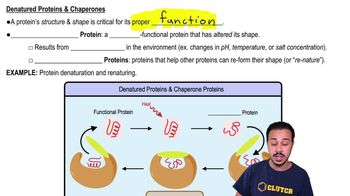
Explain how molecular chaperones facilitate protein folding in many different polypeptides, each with their own specific shape.
What type of bond is directly involved in the formation of an α-helix?
a. Peptide bonds between amino acid residues
b. Hydrogen bonds between amino acid residues
c. Van der Waals interactions between nonpolar residues
d. Disulfide bonds between cysteine residues
Which of the following correctly describe an active site? Select True or False for each statement.
T/F It is the location in an enzyme where substrates bind.
T/F It is the place where a molecule or ion binds to an inactive enzyme to induce a shape change to make it active.
T/F It is the portion of an enzyme where chaperones bind to help enzymes fold.
T/F It is the site on an enzyme where catalysis occurs.