
Ch. 32 - Deuterostome Animals
Freeman - Biological Science 8th Edition
Freeman8th EditionBiological ScienceISBN: 9780138276263당신이 사용하는 게 아니라요?교과서 변경
32장, 문제 10

Humans possess which of the following traits? Select True or False for each trait. T/F triploblasty T/F parthenogenesis T/F viviparity T/F metamorphosis

검증된 단계별 안내
1
Identify the meaning of each term: Triploblasty refers to organisms that develop from three germ layers (ectoderm, mesoderm, and endoderm). Parthenogenesis is a form of asexual reproduction where an offspring is produced without fertilization. Viviparity is a mode of reproduction in which the embryo develops inside the body of the mother, leading to live birth. Metamorphosis is a biological process by which an animal physically develops after birth or hatching, involving a conspicuous and relatively abrupt change in the animal's body structure.
Assess the relevance of each trait to humans: Humans are triploblastic, meaning they develop from three germ layers. Humans do not reproduce through parthenogenesis; they reproduce sexually requiring fertilization. Humans are viviparous, giving birth to live young rather than laying eggs. Humans do not undergo metamorphosis as their development involves gradual maturation and not abrupt changes in form.
Assign True or False based on the assessment: Triploblasty is true for humans as they develop from three germ layers. Parthenogenesis is false for humans as they reproduce sexually. Viviparity is true for humans as they give birth to live young. Metamorphosis is false for humans as they do not undergo abrupt changes in form after birth.
Review the assignment for accuracy: Ensure that the True or False assignments accurately reflect human biological traits.
Finalize the response: T/F triploblasty - True, T/F parthenogenesis - False, T/F viviparity - True, T/F metamorphosis - False

비슷한 문제에 대한 검증된 영상 답변:

이 영상 해법은 위 문제에 도움이 된다고 튜터들이 추천한 것입니다.
영상 길이:
1m
도움이 되었나요?

주요 개념

질문에 올바르게 답하기 위해 반드시 이해해야 하는 핵심 개념들은 다음과 같습니다.

Triploblasty

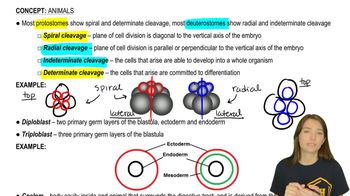
Triploblasty refers to the presence of three primary germ layers in the embryo: ectoderm, mesoderm, and endoderm. This characteristic is typical of higher animals, including humans, and is crucial for the development of complex tissues and organs. Understanding triploblasty helps in comprehending the evolutionary relationships among different animal groups.
추천 영상:
12:01
Overview of Animals - 3

Parthenogenesis

Parthenogenesis is a form of asexual reproduction where an egg develops into an organism without fertilization. While it is common in some invertebrates and plants, humans do not reproduce this way. Recognizing the distinction between sexual and asexual reproduction is essential for understanding human reproductive biology.
추천 영상:
06:30
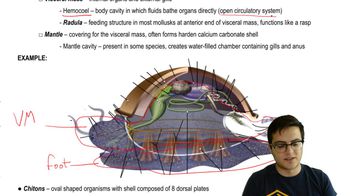
Mollusks

Viviparity

Viviparity is a reproductive strategy where embryos develop inside the body of the mother, leading to live birth. Humans are viviparous, as they give birth to live young rather than laying eggs. This concept is important for understanding human development and the maternal-fetal relationship during pregnancy.
추천 영상:
03:44
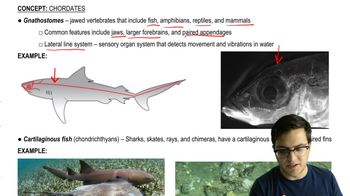
Gnathostomes
관련 실천
교과서 질문

Consider the evolution of protostomes and deuterostomes (this chapter):

Compare adaptations in protostomes and deuterostomes for living on land.

Recall that changes in the expression patterns of tool-kit genes in arthropods such as insects enabled a dramatic diversification of their segmented appendages and bodies.

Design an experiment to test whether this concept applies to vertebrates.

1198
views
교과서 질문

The size and shape of the vertebrate skull can reveal a great deal about an animal's lifestyle and evolutionary relationships. Consider your own skull. If you put your finger in your ear and move your jaw up and down, you can feel the space near the hinge of your jaw. Nestled in this space are the tiny bones that make your hearing possible: the malleus, incus, and stapes. All mammals have these three ear bones, but reptiles such as this T. rex don't. Where did ear bones come from? How is the opossum related to you?

Select True or False for each statement.

T/F An opossum is an animal, but I am a human.

T/F An opossum is a mammal, but I am a human.

T/F An opossum is a marsupial, but I am a placental mammal.

T/F The opossum and I are both tetrapods.

562
views
교과서 질문

The size and shape of the vertebrate skull can reveal a great deal about an animal's lifestyle and evolutionary relationships. Consider your own skull. If you put your finger in your ear and move your jaw up and down, you can feel the space near the hinge of your jaw. Nestled in this space are the tiny bones that make your hearing possible: the malleus, incus, and stapes. All mammals have these three ear bones, but reptiles such as this T. rex don't.

Where did ear bones come from?

Analyze the morphological data shown here and write a hypothesis to explain the origin of mammalian ear bones. (The cynodont shown is one of many extinct synapsid amniotes that lived early in the lineage that gave rise to mammals.)

504
views
교과서 질문

Draw a phylogeny of major populations of modern humans that would reject the out-of-Africa hypothesis.

1060
views
교과서 질문

The size and shape of the vertebrate skull can reveal a great deal about an animal's lifestyle and evolutionary relationships. Consider your own skull. If you put your finger in your ear and move your jaw up and down, you can feel the space near the hinge of your jaw. Nestled in this space are the tiny bones that make your hearing possible: the malleus, incus, and stapes. All mammals have these three ear bones, but reptiles such as this T. rex don't. Where did ear bones come from? The illustration of the opossum skull shows that the ear bones are completely separated from the jawbone (as they are in all mammals).

Pose a hypothesis to explain why this separation could be an adaptation that contributed to the radiation of mammals into diverse niches, including a nocturnal lifestyle.

644
views
교과서 질문

Genetic diversity in living human populations is highest in Africa and decreases as a function of distance traveled by the human migration that left Africa many millennia ago. Draw a graph to show this trend. (Hint: What is the independent variable? What is the dependent variable? What kind of graph is appropriate for this kind of data? Add a label where you would expect to find a data point for the Yanomamö tribe of the Amazon rain forest in South America. Why is it important to use indigenous people for this study?

984
views