Ch. 32 - Deuterostome Animals
Freeman - Biological Science 8th Edition
Freeman8th EditionBiological ScienceISBN: 9780138276263당신이 사용하는 게 아니라요?교과서 변경
32장, 문제 7

Which of the following nested monophyletic groups are correctly organized from largest (most inclusive) to smallest (least inclusive), showing your place in the tree of life?


a. Deuterostomes>Chordates>Vertebrates>Mammals
b. Animals>Mammals>Vertebrates>Primates
c. Chordates>Primates>Mammals>Hominins

검증된 단계별 안내
1
Identify the meaning of 'monophyletic group': A monophyletic group, or clade, is a group of organisms that consists of all the descendants of a common ancestor.
Understand the hierarchy of biological classification: The hierarchy typically follows this pattern from largest to smallest: Domain, Kingdom, Phylum, Class, Order, Family, Genus, Species.
Analyze each option to determine if the groups are listed from most inclusive (largest) to least inclusive (smallest) based on the known biological classification hierarchy.
Option a: Deuterostomes > Chordates > Vertebrates > Mammals. Here, Deuterostomes is a superphylum that includes several phyla including Chordata. Chordates include all vertebrates and some other closely related invertebrates. Vertebrates are a subphylum of chordates, and mammals are a class within the vertebrates.
Option b: Animals > Mammals > Vertebrates > Primates. This sequence is incorrect because Primates are a part of the class Mammalia, and thus should not be placed after Vertebrates. Mammals are a class within the subphylum Vertebrates.
Option c: Chordates > Primates > Mammals > Hominins. This sequence is incorrect because Primates are an order within the class Mammalia, and Hominins are a tribe within the family Hominidae of the order Primates. Thus, the order should be Chordates > Mammals > Primates > Hominins.

주요 개념

질문에 올바르게 답하기 위해 반드시 이해해야 하는 핵심 개념들은 다음과 같습니다.

Monophyletic Groups

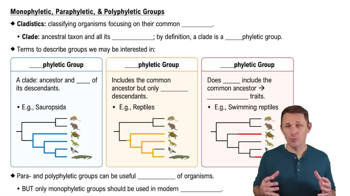
Monophyletic groups, or clades, consist of an ancestor and all its descendants, representing a complete branch on the tree of life. Understanding these groups is essential for classifying organisms based on evolutionary relationships. For example, the group 'Mammals' includes all species that share a common ancestor that was a mammal, distinguishing them from other vertebrates.
추천 영상:
가이드 코스
06:37
Monophyletic, Paraphyletic, & Polyphyletic Group

Taxonomic Hierarchy

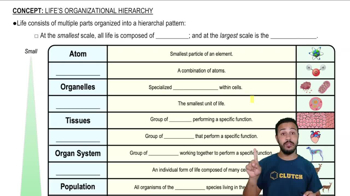
The taxonomic hierarchy is a system used to organize biological diversity into ranked categories, from broad to specific. The main levels include domain, kingdom, phylum, class, order, family, genus, and species. This hierarchy helps in understanding the relationships and classifications of organisms, such as how 'Chordates' encompass a wide range of species, including 'Mammals' and 'Primates.'
추천 영상:
09:50
Life's Organizational Hierarchy

Nested Hierarchies

Nested hierarchies refer to the way in which groups of organisms are organized within larger groups, where each level of classification is contained within the broader category. This concept is crucial for understanding evolutionary relationships, as it illustrates how specific groups, like 'Mammals,' fit within larger categories, such as 'Vertebrates' and 'Deuterostomes,' reflecting their evolutionary lineage.
추천 영상:
09:50
Life's Organizational Hierarchy
관련 실천
교과서 질문

Consider the evolution of protostomes and deuterostomes (this chapter):

Compare adaptations in protostomes and deuterostomes for living on land.

Recall that changes in the expression patterns of tool-kit genes in arthropods such as insects enabled a dramatic diversification of their segmented appendages and bodies.

Design an experiment to test whether this concept applies to vertebrates.

1198
views
교과서 질문

Most species of hominins are known only from Africa. Which species have been found in other parts of the world as well?


a. early Homo—H. habilis and H. ergaster

b. H. erectus, H. neanderthalensis, and H. floresiensis

c. Australopithecus afarensis

344
views
교과서 질문

Which statement is true about endothermy in mammals and birds?

a. They both inherited this trait from a common ancestor.

b. Birds are more closely related to mammals than to reptiles.

c. Endothermy arose independently in these two lineages.

d. Birds are reptiles and all reptiles are ectothermic.

683
views
교과서 질문

Draw a phylogeny of major populations of modern humans that would reject the out-of-Africa hypothesis.

1060
views
교과서 질문

Compare amniotic eggs to placentas.

1054
views
교과서 질문

Genetic diversity in living human populations is highest in Africa and decreases as a function of distance traveled by the human migration that left Africa many millennia ago. Draw a graph to show this trend. (Hint: What is the independent variable? What is the dependent variable? What kind of graph is appropriate for this kind of data? Add a label where you would expect to find a data point for the Yanomamö tribe of the Amazon rain forest in South America. Why is it important to use indigenous people for this study?

984
views