Ch. 39 - Animal Form and Function
Freeman - Biological Science 8th Edition
Freeman8th EditionBiological ScienceISBN: 9780138276263당신이 사용하는 게 아니라요?교과서 변경
39장, 문제 8

a. Consider three spheres with radii of 1 cm, 5 cm, and 10 cm. Based on what you read in the chapter, predict which sphere will have the highest surface area to volume ratio, and which sphere will have the lowest.
b. Next, calculate the surface area and the volume of each sphere. (Surface area of a sphere=4𝜋𝑟2; volume of a sphere=(4/3)𝜋𝑟3.) Plot the results on a graph with radius on the 𝑥-axis and surface area and volume on the 𝑦-axis.
c. Which sphere has the highest surface area to volume ratio? The lowest? Explain how the graph shows the relationship between size and surface area to volume ratio.
d. Now imagine that these spheres represent a small, medium, and large endothermic animal. Which animal would lose heat most rapidly? Explain using the surface area to volume ratio.

검증된 단계별 안내
1
a. To predict which sphere will have the highest and lowest surface area to volume ratio, recall that as the radius of a sphere increases, the volume increases faster than the surface area. Therefore, the smallest sphere (radius = 1 cm) will likely have the highest surface area to volume ratio, and the largest sphere (radius = 10 cm) will have the lowest.
b. To calculate the surface area and volume for each sphere, use the formulas provided: Surface area = 4πr^2 and Volume = (4/3)πr^3. Calculate these values for each sphere with radii of 1 cm, 5 cm, and 10 cm. Then, plot these values on a graph with the radius on the x-axis and both surface area and volume on the y-axis, using different colors or markers for each to distinguish them.
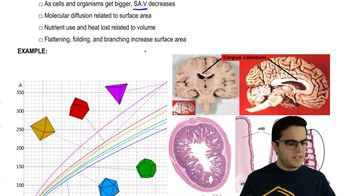
c. To determine which sphere has the highest and lowest surface area to volume ratio, calculate the ratio for each sphere using the formula: Surface Area to Volume Ratio = Surface Area / Volume. Compare these ratios for all three spheres. The graph will show that as the radius increases, the surface area to volume ratio decreases, illustrating the relationship between size and this ratio.
d. Considering these spheres as models for endothermic animals, the animal represented by the smallest sphere (with the highest surface area to volume ratio) would lose heat most rapidly. This is because a higher surface area to volume ratio means more surface area relative to volume, which facilitates greater heat loss to the environment.

주요 개념

질문에 올바르게 답하기 위해 반드시 이해해야 하는 핵심 개념들은 다음과 같습니다.

Surface Area to Volume Ratio

The surface area to volume ratio (SA:V) is a measure that describes how much surface area an object has relative to its volume. As the size of an object increases, its volume grows faster than its surface area, leading to a decrease in the SA:V ratio. This concept is crucial in biology, particularly in understanding how organisms exchange materials with their environment, as a higher SA:V ratio facilitates more efficient exchange processes.
추천 영상:
07:47
Surface Area to Volume Ratio

Formulas for Surface Area and Volume of a Sphere

The surface area and volume of a sphere can be calculated using specific mathematical formulas: the surface area is given by 4πr², and the volume is calculated as (4/3)πr³, where r is the radius of the sphere. These formulas are essential for determining the physical properties of the spheres in the question, allowing for comparisons of their sizes and the implications of these measurements in biological contexts.
추천 영상:
07:47
Surface Area to Volume Ratio

Impact of Size on Heat Loss in Endothermic Animals

In endothermic animals, the rate of heat loss is influenced by their surface area to volume ratio. Smaller animals, with a higher SA:V ratio, lose heat more rapidly than larger animals, which have a lower SA:V ratio. This relationship is significant in understanding thermoregulation and energy expenditure in different-sized animals, as it affects their survival strategies in varying environmental conditions.
추천 영상:
03:00
Geographic Impact on Communities Example 1
관련 실천
교과서 질문

Explain why most endotherms are homeothermic and most ectotherms are poikilothermic.

1029
views
교과서 질문

Explain why it would be impossible for a gorilla the size of King Kong to have fur. (Your answer should explain how the surface area to volume ratio of a normal-sized gorilla would compare to Kong's; relate this to the role of surface area and volume in heat generation and heat transfer, and consider the function of fur.)

665
views
교과서 질문

Consider three spheres with radii of 1 cm, 5 cm, and 10 cm.

Calculate the surface area and the volume of each sphere, and plot the results on a graph with radius on the x-axis and surface area and volume on the y-axis. (Surface area of a sphere = 4πr2; volume of a sphere = (4/3)πr3.)

Explain how the graph shows the relationship between size and surface area to volume ratio.

1342
views
교과서 질문

For each of the following, explain how structure relates to function:

absorptive sections of the digestive tract;

capillaries;

beaks of Galápagos finches;

fish gills.

660
views
교과서 질문

The dinosaur Apatosaurus (Brontosaurus) is one of the largest terrestrial animals that ever lived—over 20 m in length and weighing over 20 metric tons. Is it more likely that Apatosaurus was homeothermic or poikilothermic? Explain.

726
views
교과서 질문

The metabolic rate of a frog in summer (at 35°C) is about eight times higher than in winter (at 5°C). Compare and contrast the frog's ability to move, exchange gases, and digest food at the two temperatures.

During which season will the frog require more food energy, and why?

849
views