Ch. 43 - Animal Nervous Systems
Freeman - Biological Science 8th Edition
Freeman8th EditionBiological ScienceISBN: 9780138276263당신이 사용하는 게 아니라요?교과서 변경
43장, 문제 3

In a neuron, what creates the electrochemical gradient favoring the outflow of K+ when the cell is at rest?
a. Na+/K+-ATPase
b. Voltage-gated K+ channels
c. Voltage-gated Na+ channels
d. Ligand-gated Na+/K+ channels

검증된 단계별 안내
1
Understand the concept of electrochemical gradient: It is the combination of electrical and chemical gradients that influence the movement of ions across a membrane.
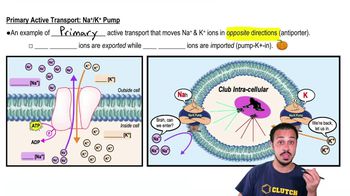
Identify the role of Na+/K+-ATPase: This enzyme actively transports 3 Na+ ions out of the neuron and 2 K+ ions into the neuron, using ATP. This creates a concentration gradient with more Na+ outside and more K+ inside the cell.
Recognize the resting membrane potential: At rest, the inside of the neuron is negatively charged relative to the outside, primarily due to the activity of Na+/K+-ATPase and the presence of negatively charged proteins inside the cell.
Consider the movement of K+ ions: The concentration gradient created by Na+/K+-ATPase favors the outflow of K+ ions, as there is a higher concentration of K+ inside the cell compared to outside.
Evaluate the options: Na+/K+-ATPase is responsible for maintaining the concentration gradient that favors the outflow of K+ when the neuron is at rest, making it the correct answer.

비슷한 문제에 대한 검증된 영상 답변:

이 영상 해법은 위 문제에 도움이 된다고 튜터들이 추천한 것입니다.
영상 길이:
2m

주요 개념

질문에 올바르게 답하기 위해 반드시 이해해야 하는 핵심 개념들은 다음과 같습니다.

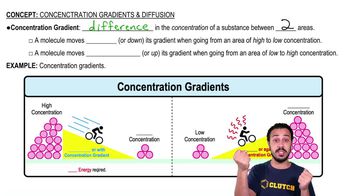
Electrochemical Gradient

An electrochemical gradient is a gradient of electrochemical potential, usually for an ion that can move across a membrane. It consists of two parts: the electrical potential and a difference in the chemical concentration across a membrane. In neurons, this gradient is crucial for the movement of ions like K+ and Na+, influencing the cell's resting membrane potential.
추천 영상:
04:51
Concentration Gradients and Diffusion

Na+/K+-ATPase Pump

The Na+/K+-ATPase pump is an essential membrane protein that uses ATP to transport three Na+ ions out of the cell and two K+ ions into the cell. This active transport mechanism helps maintain the resting membrane potential by creating a high concentration of K+ inside the cell and a high concentration of Na+ outside, contributing to the electrochemical gradient.
추천 영상:
06:57
Primary Active Transport: Na+/K+ Pump

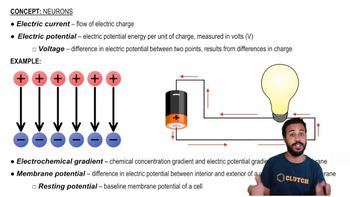
Resting Membrane Potential

The resting membrane potential is the voltage difference across the neuronal membrane when the cell is not transmitting a signal. It is typically around -70 mV in neurons, primarily due to the differential distribution of ions, especially K+ and Na+, across the membrane, maintained by the Na+/K+-ATPase pump and selective permeability to K+.
추천 영상:
10:31
Membrane Potential