Ch. 43 - Animal Nervous Systems
Freeman - Biological Science 8th Edition
Freeman8th EditionBiological ScienceISBN: 9780138276263당신이 사용하는 게 아니라요?교과서 변경
43장, 문제 5

Explain the difference between a ligand-gated K+ channel and a voltage-gated K+ channel.

검증된 단계별 안내
1
Understand the basic function of ion channels: Ion channels are proteins that allow ions to pass through the cell membrane, playing a crucial role in cell signaling and homeostasis.
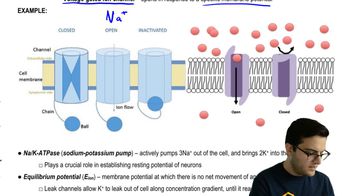
Define ligand-gated channels: Ligand-gated channels open or close in response to the binding of a specific molecule, known as a ligand, which can be a neurotransmitter or hormone.
Define voltage-gated channels: Voltage-gated channels open or close in response to changes in the electrical potential across the cell membrane.
Compare the activation mechanisms: Ligand-gated K+ channels require the binding of a ligand to change their conformation and allow K+ ions to pass through, whereas voltage-gated K+ channels respond to changes in membrane potential to open or close.
Discuss the physiological roles: Ligand-gated K+ channels are often involved in synaptic transmission and cellular signaling, while voltage-gated K+ channels are crucial for action potential propagation and regulating neuronal excitability.

비슷한 문제에 대한 검증된 영상 답변:

이 영상 해법은 위 문제에 도움이 된다고 튜터들이 추천한 것입니다.
영상 길이:
53s
도움이 되었나요?

주요 개념

질문에 올바르게 답하기 위해 반드시 이해해야 하는 핵심 개념들은 다음과 같습니다.

Ligand-Gated Ion Channels

Ligand-gated ion channels are a type of membrane protein that open or close in response to the binding of a specific chemical messenger, or ligand, such as a neurotransmitter. This binding alters the channel's conformation, allowing ions to pass through the membrane, which can initiate a cellular response. These channels are crucial in synaptic transmission and cellular signaling.
추천 영상:
가이드 코스
08:38
Ion Channels and Pumps

Voltage-Gated Ion Channels

Voltage-gated ion channels are membrane proteins that open or close in response to changes in the electrical potential across the cell membrane. These channels are essential for the propagation of action potentials in neurons and muscle cells, as they allow ions to flow in response to voltage changes, facilitating rapid communication and contraction processes.
추천 영상:
가이드 코스
08:38
Ion Channels and Pumps

Potassium Ion Channels

Potassium ion channels are a class of ion channels that selectively allow potassium ions (K+) to pass through the cell membrane. They play a critical role in maintaining the cell's resting membrane potential and in repolarizing the membrane after an action potential. The specific gating mechanism, whether ligand or voltage, determines how these channels are activated and contribute to cellular function.
추천 영상:
가이드 코스
08:38
Ion Channels and Pumps
관련 실천
교과서 질문

Describe the role of summation in postsynaptic cells.

1010
views

교과서 질문

Which of these statements about myelination in neurons is/are correct? Select True or False for each statement.

T/FIt speeds propagation by increasing the density of voltage-gated channels all along the axon.

T/FMultiple sclerosis is characterized by disrupted myelination of certain neurons in the central nervous system.

T/FIt speeds propagation by preventing cations from leaking out across the membrane as they spread down the axon.

T/FIt is more commonly observed in vertebrates than in invertebrates.

1146
views
교과서 질문

Why is memory thought to involve changes in particular synapses?

a. At some synapses, more neurotransmitters are released after learning takes place.

b. At some synapses, a different type of neurotransmitter is released after learning takes place.

c. When researchers stimulated certain neurons electrically, individuals replayed memories.

d. When researchers changed synapses in the brains of patients during surgery, the patients' memories changed.

820
views
교과서 질문

In a neuron, what creates the electrochemical gradient favoring the outflow of K+ when the cell is at rest?

a. Na+/K+-ATPase

b. Voltage-gated K+ channels

c. Voltage-gated Na+ channels

d. Ligand-gated Na+/K+ channels

1062
views
교과서 질문

Which of the following brain regions is responsible for the formation of new memories?

a. Brainstem

b. Cerebellum

c. Frontal lobe

d. Hippocampus

1249
views
교과서 질문

Compare and contrast the somatic nervous system and autonomic nervous system.

1522
views