

Ch. 45 - Animal Movement
Freeman - Biological Science 8th Edition
Freeman8th EditionBiological ScienceISBN: 9780138276263당신이 사용하는 게 아니라요?교과서 변경
45장, 문제 5

How did data on sarcomere structure inspire the sliding-filament model of muscle contraction?
Explain why the observation that muscle cells contain many mitochondria and extensive smooth endoplasmic reticulum turned out to be logical once the molecular mechanism of muscular contraction was understood.

검증된 단계별 안내
1
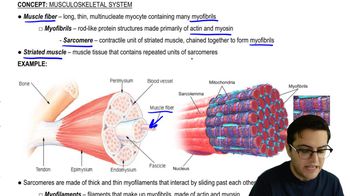
Begin by understanding the structure of a sarcomere, which is the basic unit of a muscle fiber. A sarcomere is composed of thick filaments (myosin) and thin filaments (actin) that are arranged in a repeating pattern. This structure is crucial for muscle contraction.
The sliding-filament model was inspired by observations of sarcomere structure during muscle contraction. Researchers noticed that the length of the sarcomere changes as the muscle contracts, but the lengths of the individual filaments remain constant. This led to the hypothesis that the filaments slide past each other, rather than shortening, to produce contraction.
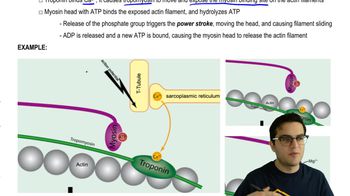
Consider the role of ATP in muscle contraction. ATP is required for the myosin heads to bind to actin filaments and then detach after the power stroke. This cycle of binding and detachment is essential for the sliding-filament mechanism, which explains why muscle cells contain many mitochondria. Mitochondria are the powerhouses of the cell, providing the necessary ATP for sustained muscle contraction.
The presence of extensive smooth endoplasmic reticulum (SER) in muscle cells is logical because the SER is involved in calcium storage and release. Calcium ions are crucial for muscle contraction as they bind to troponin, causing a conformational change that allows myosin to bind to actin. This process is integral to the sliding-filament model.
Summarize how the sliding-filament model and the cellular components of muscle cells (mitochondria and SER) work together to facilitate muscle contraction. The model explains the mechanical aspect of contraction, while the cellular components provide the necessary energy and regulatory ions to support this process.

비슷한 문제에 대한 검증된 영상 답변:

이 영상 해법은 위 문제에 도움이 된다고 튜터들이 추천한 것입니다.
영상 길이:
4m
도움이 되었나요?

주요 개념

질문에 올바르게 답하기 위해 반드시 이해해야 하는 핵심 개념들은 다음과 같습니다.

Sarcomere Structure

The sarcomere is the fundamental unit of a muscle fiber, composed of actin and myosin filaments. Its structure, characterized by the arrangement of these filaments, is crucial for muscle contraction. Observations of sarcomere shortening during contraction led to the development of the sliding-filament model, which explains how muscles contract by the sliding of actin over myosin.
추천 영상:
02:40
Muscle Fibers and Sarcomeres

Sliding-Filament Model

The sliding-filament model describes the process of muscle contraction where actin filaments slide past myosin filaments, shortening the sarcomere and thus the muscle. This model was inspired by the observation of sarcomere structure and dynamics, providing a molecular explanation for how muscles generate force and movement.
추천 영상:
04:30
Sliding Filament Model

Role of Mitochondria and Smooth Endoplasmic Reticulum

Muscle cells are rich in mitochondria and smooth endoplasmic reticulum, which are essential for energy production and calcium storage, respectively. Mitochondria supply ATP needed for muscle contraction, while the smooth endoplasmic reticulum regulates calcium ions, crucial for initiating contraction. Understanding these roles clarified why these organelles are abundant in muscle cells.
추천 영상:
06:07
Endoplasmic Reticulum
관련 실천
교과서 질문

Which of the following is critical to the function of most exoskeletons, endoskeletons, and hydrostatic skeletons?

a. Muscles interact with the skeleton in antagonistic groups.

b. Muscles attach to each of these types of skeletons via tendons.

c. Muscles extend joints by pushing skeletal elements.

d. Segments of the body or limbs are extended when paired muscles relax in unison.

669
views
교과서 질문

In muscle cells, myosin molecules continue moving along actin molecules as long as:

a. ATP is present and troponin is not bound to Ca²⁺.

b. ADP is present and tropomyosin is released from intracellular stores.

c. ADP is present and the intracellular acetylcholine level is high.

d. ATP is present and the intracellular Ca²⁺ concentration is high.

1229
views
교과서 질문

Rigor mortis is the stiffening of a body after death that occurs when myosin binds to actin but cannot unbind. What prevents myosin from unbinding?

1779
views
교과서 질문

In 2023, Tigist Assefa of Ethiopia set a new record with a time of 2 hours, 11 minutes, and 53 seconds. Scientists, trainers, and athletes alike have wondered about the extent to which muscle structure and function contribute to success in athletes such as Assefa. What makes elite distance runners so good? Are their muscles somehow different from those of less successful athletes and non-athletes? Compare and contrast the structure and function of the three types of skeletal muscle fibers.

253
views
교과서 질문

Which of the following statements regarding control of muscle tissue is/are correct? Select True or False for each statement.

T/F All skeletal muscles are voluntary.

T/F Cardiac muscle is involuntary.

T/F Some smooth muscle tissues are voluntary, and others are involuntary.

T/F Parasympathetic and sympathetic neurons innervate skeletal, cardiac, and smooth muscle tissues.

851
views
교과서 질문

In 2023, Tigist Assefa of Ethiopia set a new record with a time of 2 hours, 11 minutes, and 53 seconds. Scientists, trainers, and athletes alike have wondered about the extent to which muscle structure and function contribute to success in athletes such as Assefa. What makes elite distance runners so good? Are their muscles somehow different from those of less successful athletes and non-athletes? Predict who would likely have a greater proportion of fast glycolytic fibers in their gastrocnemius (calf) muscle—an elite distance runner or an elite sprinter. Explain.

187
views