Ch. 49 - An Introduction to Ecology
Freeman - Biological Science 8th Edition
Freeman8th EditionBiological ScienceISBN: 9780138276263당신이 사용하는 게 아니라요?교과서 변경
49장, 문제 9

Like Earth, Mars has seasons—its Northern Hemisphere experiences winter when its Southern Hemisphere experiences summer. Which statement is the best explanation for seasonality on Mars?
a. Mars is tilted on its axis.
b. Mars has an elliptical orbit that brings it closer to the Sun in summer than in winter.
c. Mars has a circular orbit and maintains a constant distance from the Sun.
d. The Southern Hemisphere of Mars consistently receives direct solar radiation.

검증된 단계별 안내
1
Begin by understanding the concept of seasonality on planets. Seasons are typically caused by the tilt of a planet's axis relative to its orbit around the Sun.
Consider option a: Mars is tilted on its axis. This is similar to Earth, where the axial tilt causes different parts of the planet to receive varying amounts of sunlight throughout the year, leading to seasons.
Evaluate option b: Mars has an elliptical orbit that brings it closer to the Sun in summer than in winter. While Mars does have an elliptical orbit, the primary cause of seasons is usually the axial tilt, not the distance from the Sun.
Examine option c: Mars has a circular orbit and maintains a constant distance from the Sun. A circular orbit would not cause significant seasonal changes, as the distance from the Sun would remain constant.
Consider option d: The Southern Hemisphere of Mars consistently receives direct solar radiation. This statement does not explain the alternating seasons between hemispheres, which is a characteristic of axial tilt.

비슷한 문제에 대한 검증된 영상 답변:

이 영상 해법은 위 문제에 도움이 된다고 튜터들이 추천한 것입니다.
영상 길이:
1m
도움이 되었나요?

주요 개념

질문에 올바르게 답하기 위해 반드시 이해해야 하는 핵심 개념들은 다음과 같습니다.

Axial Tilt

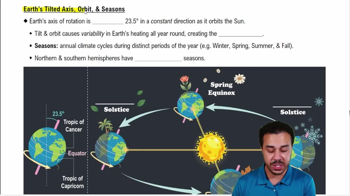
Axial tilt, or obliquity, refers to the angle at which a planet's rotational axis is tilted relative to its orbital plane. This tilt is responsible for the changing seasons on planets like Earth and Mars, as it causes different hemispheres to receive varying amounts of sunlight throughout the year. Mars has an axial tilt of about 25 degrees, similar to Earth's 23.5 degrees, leading to its seasonal changes.
추천 영상:
가이드 코스
02:17
Earth’s Tilted Axis, Orbit, & Seasons

Elliptical Orbit

An elliptical orbit is an oval-shaped path that a planet follows around the Sun. While Mars does have an elliptical orbit, it is not the primary reason for its seasons. The variation in distance from the Sun due to this orbit is not significant enough to cause the seasonal changes observed on Mars. Instead, the axial tilt plays a more crucial role in the planet's seasonality.
추천 영상:
가이드 코스
09:44
Electron Orbitals & Energy Shells

Solar Radiation Distribution

Solar radiation distribution refers to how sunlight is spread across a planet's surface. The axial tilt of a planet affects this distribution, leading to varying intensities of sunlight in different regions and times of the year. On Mars, as on Earth, this results in one hemisphere receiving more direct sunlight during its summer, while the other experiences winter, contributing to the seasonal cycle.
추천 영상:
05:24
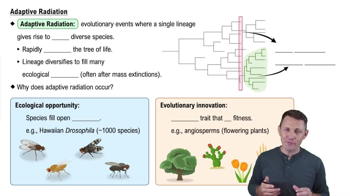
Adaptive Radiation
관련 실천
교과서 질문

Explain how the open ocean is similar to the desert, and how it is not.

1101
views

교과서 질문

Temperate forest in China and temperate forest in North America are part of the same biome but are distinct ecosystems. Explain.

768
views
교과서 질문

<Image?

The red lionfish, Pterois volitans, has beautiful red stripes, streaming fins, and a fearless disposition, and it is deadly. Native to the Pacific Ocean, the red lionfish was first discovered on coral reefs in the Bahamas in 1985. The species has spread to over 3 million square kilometers of the western Atlantic and Gulf of Mexico. Lionfish have a voracious appetite for native fish, are armed with venomous spines, and have no natural predators in their new range.

Lionfish are usually found in full-salinity seawater (35 parts per thousand). However, lab studies show that lionfish can tolerate salinities as low as 4 parts per thousand for several days, suggesting that the low-salinity water of estuaries (such as at the mouth of the Amazon River) may not be a barrier to lionfish dispersal along the coasts. Sketch a niche model predicting lionfish abundance as a function of salinity.

970
views
교과서 질문

Scientists predict that global climate change will cause a greater increase in average temperature at higher latitudes than in the tropics. This seems like good news since most of the world's biodiversity occurs in the tropics. However, recent data suggest that a smaller temperature change in the tropics will cause a larger physiological response in organisms there than the larger temperature change will in organisms in temperate areas. Based on what you have learned about thermal niches in this chapter, propose a hypothesis to explain this result.

1374
views
교과서 질문

<Image?

The red lionfish, Pterois volitans, has beautiful red stripes, streaming fins, and a fearless disposition, and it is deadly. Native to the Pacific Ocean, the red lionfish was first discovered on coral reefs in the Bahamas in 1985. The species has spread to over 3 million square kilometers of the western Atlantic and Gulf of Mexico. Lionfish have a voracious appetite for native fish, are armed with venomous spines, and have no natural predators in their new range.

Why are species like the lionfish considered 'invasive'?

a. They are found in areas where they are not native.

b. They were accidentally introduced by humans.

c. They spread aggressively and displace native species.

d. They are predators of other fish.

1066
views
교과서 질문

Compare the distribution of the natural terrestrial biomes of eastern North America with the distribution of anthropogenic biomes.

656
views