Ch. 5 - An Introduction to Carbohydrates
Freeman - Biological Science 8th Edition
Freeman8th EditionBiological ScienceISBN: 9780138276263당신이 사용하는 게 아니라요?교과서 변경
5장, 문제 1

What are three ways monosaccharides differ from one another?

검증된 단계별 안내
1
1. Monosaccharides, also known as simple sugars, can differ in the number of carbon atoms they contain. For example, glucose and fructose both have six carbon atoms (hexoses), while ribose has five (pentose).
2. Monosaccharides can also differ in the position of their carbonyl group. If the carbonyl group is at the end of the carbon chain, the sugar is an aldose (like glucose). If the carbonyl group is within the carbon chain, the sugar is a ketose (like fructose).
3. Lastly, monosaccharides can differ in the spatial arrangement of their atoms. For instance, glucose and galactose are both aldohexoses, but they differ in the orientation of the hydroxyl group (-OH) on the fourth carbon atom.

비슷한 문제에 대한 검증된 영상 답변:

이 영상 해법은 위 문제에 도움이 된다고 튜터들이 추천한 것입니다.
영상 길이:
2m
도움이 되었나요?

주요 개념

질문에 올바르게 답하기 위해 반드시 이해해야 하는 핵심 개념들은 다음과 같습니다.

Structure of Monosaccharides

Monosaccharides are the simplest form of carbohydrates, consisting of single sugar units. They can differ in their carbon chain length, typically ranging from three to seven carbons. The arrangement of these carbon atoms, along with the presence of functional groups like hydroxyl (-OH) and carbonyl (C=O), contributes to the structural diversity among monosaccharides.
추천 영상:
가이드 코스
04:25
Community Structure

Isomerism in Monosaccharides

Monosaccharides can exist as isomers, which are compounds with the same molecular formula but different structural arrangements. This includes structural isomers, where the connectivity of atoms differs, and stereoisomers, where the spatial arrangement of atoms varies. For example, glucose and fructose are both C6H12O6 but differ in structure and properties.
추천 영상:
가이드 코스
03:08
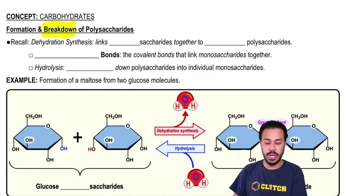
Formation & Breakdown of Polysaccharides

Functional Groups and Properties

The presence and arrangement of functional groups in monosaccharides significantly influence their chemical properties and reactivity. For instance, the location of the carbonyl group (aldehyde or ketone) determines whether a monosaccharide is classified as an aldose or a ketose. These differences affect how monosaccharides participate in biochemical reactions and their roles in metabolism.
추천 영상:
가이드 코스
06:04
Functional Groups