
Ch. 50 - Behavioral Ecology
Freeman - Biological Science 8th Edition
Freeman8th EditionBiological ScienceISBN: 9780138276263당신이 사용하는 게 아니라요?교과서 변경
50장, 문제 8

Hamilton's rule states that an altruistic allele could spread in a population if Br > C, where B represents the fitness benefit to the recipient, r is the coefficient of relatedness between altruist and recipient, and C represents the fitness cost to the altruist. If r = 0.5 between the altruist and the recipient, what would the ratio of costs to benefits have to be for the altruistic allele to spread?
a. C/ B > 0.5
b. C/ B > 0
c. C/ B < 0.5
d. C/ B < 0

검증된 단계별 안내
1
Understand Hamilton's rule: Br > C, where B is the benefit to the recipient, r is the coefficient of relatedness, and C is the cost to the altruist.
Substitute the given value of r into the inequality: 0.5B > C.
Rearrange the inequality to express the cost-to-benefit ratio: C/B < 0.5.
Interpret the inequality: For the altruistic allele to spread, the cost-to-benefit ratio (C/B) must be less than 0.5.
Compare the options provided with the derived inequality to determine the correct answer.

비슷한 문제에 대한 검증된 영상 답변:

이 영상 해법은 위 문제에 도움이 된다고 튜터들이 추천한 것입니다.
영상 길이:
2m
도움이 되었나요?

주요 개념

질문에 올바르게 답하기 위해 반드시 이해해야 하는 핵심 개념들은 다음과 같습니다.

Hamilton's Rule

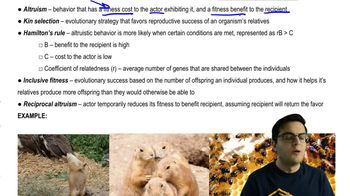
Hamilton's Rule is a principle in evolutionary biology that predicts when an altruistic behavior will spread in a population. It states that an altruistic allele can increase in frequency if the genetic relatedness (r) between the altruist and the recipient, multiplied by the benefit to the recipient (B), is greater than the cost to the altruist (C). Mathematically, this is expressed as Br > C.
추천 영상:
04:33
Chargaff's Rules

Coefficient of Relatedness (r)

The coefficient of relatedness (r) is a measure of genetic similarity between two individuals. It quantifies the probability that a gene in one individual is identical by descent to a gene in another individual. For example, siblings have an r value of 0.5, meaning they share 50% of their genes, which is crucial in determining the likelihood of altruistic behavior according to Hamilton's Rule.
추천 영상:
04:08
r/K Selection

Cost-Benefit Ratio in Altruism

The cost-benefit ratio in altruism refers to the relationship between the fitness cost to the altruist (C) and the fitness benefit to the recipient (B). For an altruistic allele to spread, the ratio C/B must be less than the coefficient of relatedness (r). In the given question, with r = 0.5, the condition for the allele to spread is C/B < 0.5, making option c the correct answer.
추천 영상:
07:15
Migration and Altruism
관련 실천
교과서 질문

<Image>

Mass strandings of whales occur on beaches near military exercises where sonar is used, raising concerns about the effects of human-generated underwater sounds on animal behavior. Scientists are collecting behavioral data on several species of whales to find out how sonar affects them.

Researchers followed tagged blue whales to observe how they respond to simulated military sonar—using sound levels much lower than those typically used during military exercises. Analyze the sample of data below for one individual blue whale and summarize the behavioral effect of the sound exposure.

720
views
교과서 질문

Is it true that all organisms forage optimally? Why or why not?

951
views
교과서 질문

Evolutionary biologist Hopi Hoekstra and colleagues have hypothesized that the burrow-digging behavior of mice (and the resulting shape of their underground burrows) is heritable—innate and not learned. Design an experiment to test this hypothesis.

725
views
교과서 질문

Propose an evolutionary hypothesis to explain the observation that some bird populations do not migrate if people supply food for them in feeders.

677
views
교과서 질문

The male cuttlefish in the chapter-opening photo can rapidly change their skin colors (under nerve control) to flash warning patterns to rivals. Predict the proximate and ultimate causes of this behavior.

473
views
교과서 질문

<Image>

Mass strandings of whales occur on beaches near military exercises where sonar is used, raising concerns about the effects of human-generated underwater sounds on animal behavior. Scientists are collecting behavioral data on several species of whales to find out how sonar affects them.

Whales communicate with one another using sound. What is one benefit and one cost to whales of using sound to communicate underwater?

570
views