Ch. 53 - Ecosystems and Global Ecology
Freeman - Biological Science 8th Edition
Freeman8th EditionBiological ScienceISBN: 9780138276263당신이 사용하는 게 아니라요?교과서 변경
53장, 문제 2

True or False: Most of the net primary productivity that is consumed is used for growth by primary consumers. Explain.

검증된 단계별 안내
1
False. Most of the net primary productivity consumed by primary consumers is actually used for respiration. Only a small fraction of the energy consumed is used for growth. This is because primary consumers need to expend a significant amount of energy on metabolic processes to maintain their bodily functions, which is released as heat during respiration.
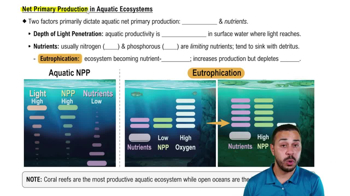
Net primary productivity (NPP) refers to the rate at which plants and other photosynthetic organisms produce organic compounds in an ecosystem minus the rate at which they use some of these compounds through respiration.
Primary consumers, such as herbivores, consume these organic compounds for energy. However, the energy transfer from primary producers to primary consumers is not very efficient, typically around 10%.
The majority of the energy consumed by primary consumers is lost through respiration, excretion, and as heat. Only about 10-20% of the consumed energy is converted into biomass that contributes to growth.
Therefore, the statement that most of the net primary productivity consumed is used for growth by primary consumers is false, as the larger portion is used for respiration and other metabolic processes.

비슷한 문제에 대한 검증된 영상 답변:

이 영상 해법은 위 문제에 도움이 된다고 튜터들이 추천한 것입니다.
영상 길이:
35s
도움이 되었나요?

주요 개념

질문에 올바르게 답하기 위해 반드시 이해해야 하는 핵심 개념들은 다음과 같습니다.

Net Primary Productivity (NPP)

Net Primary Productivity (NPP) refers to the amount of organic matter or biomass produced by photosynthetic organisms, such as plants, after accounting for the energy used in respiration. It represents the energy available to support the next trophic levels in an ecosystem, including primary consumers. Understanding NPP is crucial for evaluating energy flow and ecosystem health.
추천 영상:
04:36
Primary Production in Aquatic Ecosystems

Primary Consumers

Primary consumers are organisms that feed directly on primary producers, typically herbivores that consume plants and algae. They play a vital role in the energy transfer within an ecosystem, as they convert the energy stored in plant biomass into forms that can be utilized by higher trophic levels. Their growth and reproduction depend on the availability of NPP.
추천 영상:
04:36
Primary Production in Aquatic Ecosystems

Trophic Levels

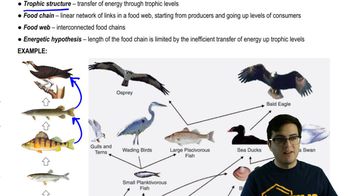
Trophic levels represent the hierarchical positions of organisms in a food chain, categorized by their feeding relationships. The first level consists of primary producers, followed by primary consumers, secondary consumers, and so on. Understanding trophic levels is essential for analyzing energy flow and the efficiency of energy transfer between different levels in an ecosystem.
추천 영상:
03:14
Trophic Structure