Ch. 53 - Ecosystems and Global Ecology
Freeman - Biological Science 8th Edition
Freeman8th EditionBiological ScienceISBN: 9780138276263당신이 사용하는 게 아니라요?교과서 변경
53장, 문제 7

Why are the open oceans nutrient poor? Why are coastal areas and intertidal habitats relatively nutrient rich?

검증된 단계별 안내
1
Step 1: Understand the concept of nutrient distribution in the ocean. The open oceans are nutrient poor because they are far from land, which is the primary source of nutrients. Nutrients are washed into the ocean from the land by rivers and rain. In the open ocean, far from land, these sources of nutrients are absent or very limited.
Step 2: Understand the role of ocean currents. Ocean currents also play a role in nutrient distribution. Deep ocean currents often carry nutrient-rich water from the ocean floor to the surface, a process known as upwelling. However, in the open ocean, these currents are often weak or absent, limiting the availability of nutrients.
Step 3: Understand the concept of nutrient cycling. In the open ocean, nutrients that are present are quickly used up by phytoplankton and other marine organisms. Once these organisms die, their remains sink to the ocean floor, taking the nutrients with them. This makes it difficult for nutrients to be recycled back into the ecosystem.
Step 4: Understand why coastal areas and intertidal habitats are nutrient rich. Coastal areas and intertidal habitats are nutrient rich because they are close to land, where nutrients are plentiful. Rivers and rain wash nutrients from the land into these areas. Additionally, the action of tides and waves can stir up the bottom sediments, releasing nutrients back into the water.
Step 5: Understand the role of human activities. Human activities, such as agriculture and urban development, can also contribute to the nutrient richness of coastal areas and intertidal habitats. Runoff from these activities can carry large amounts of nutrients into these areas.

비슷한 문제에 대한 검증된 영상 답변:

이 영상 해법은 위 문제에 도움이 된다고 튜터들이 추천한 것입니다.
영상 길이:
1m
도움이 되었나요?

주요 개념

질문에 올바르게 답하기 위해 반드시 이해해야 하는 핵심 개념들은 다음과 같습니다.

Nutrient Cycling

Nutrient cycling refers to the movement and exchange of organic and inorganic matter back into the production of living matter. In open oceans, the vast distances and limited upwelling of nutrients from the deep sea result in lower concentrations of essential nutrients like nitrogen and phosphorus, making these areas nutrient-poor.
추천 영상:
03:25
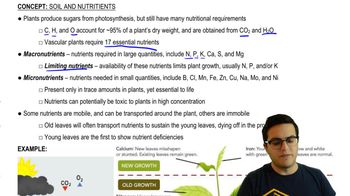
Soil Nutrients

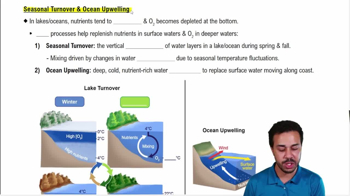
Upwelling

Upwelling is the process where deep, nutrient-rich waters rise to the surface, often due to wind patterns and ocean currents. This phenomenon is more prevalent in coastal areas, where the interaction of land and ocean promotes nutrient replenishment, leading to higher productivity and nutrient richness in these habitats.
추천 영상:
03:57
Seasonal Turnover & Ocean Upwelling

Eutrophication

Eutrophication is the enrichment of water bodies with nutrients, often leading to excessive growth of algae and depletion of oxygen. Coastal areas and intertidal habitats can experience eutrophication due to runoff from land, which introduces nutrients, contrasting with the nutrient-poor conditions of the open ocean.
추천 영상:
03:35
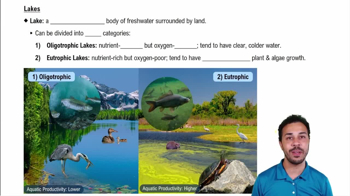
Lakes
관련 실천
교과서 질문

Explain why it is more energy efficient (in terms of the amount of total NPP required) to eat a pound of tofu (bean curd) than a pound of hamburger.

818
views
교과서 질문

Suppose that record snows blanket your campus this winter. Your friend says this is proof that global warming isn't really occurring. What is the flaw in your friend's logic?

a. The average temperature of the Earth is not actually increasing.

b. Global warming refers to temperatures, but snow is a type of precipitation.

c. While the average global temperature is increasing, local temperatures and precipitation (weather) will vary.

d. Your friend is confusing global warming and global climate change.

836
views
교과서 질문

If the GPP of a grassland is 5000 kcal/m2/year and 55 percent is used up by cellular respiration, what is the NPP?

a. 2250 kcal/m2/year

b. 2750 kcal/m2/year

c. 5000 kcal/m2/year

d. Need more data

1611
views
교과서 질문

Explain why decomposition rates in a field in Nebraska would differ from the decomposition rates in a field in the Amazon. How do decomposers regulate nutrient availability in ecosystems?

795
views
교과서 질문

During the Carboniferous period, plant growth was extensive but rates of decomposition slowed (probably due to the formation of vast, oxygen-poor swamp habitats). As a result, large amounts of biomass accumulated in terrestrial environments (much of this biomass is now coal). The fossil record indicates that atmospheric oxygen increased, atmospheric carbon dioxide decreased, and global temperatures dropped. Explain why.

1272
views
교과서 질문

In a model of the carbon cycle, how would you label an arrow from the atmosphere to plants?


a. cellular respiration

b. photosynthesis

c. decomposition

d. consumption

379
views