Ch. 6 - Lipids, Membranes, and the First Cells
Freeman - Biological Science 8th Edition
Freeman8th EditionBiological ScienceISBN: 9780138276263당신이 사용하는 게 아니라요?교과서 변경
6장, 문제 6

Draw and label the plasma membrane of a cell that is placed in a solution with concentrations of calcium ions and lactose that are greater than those on the inside of the cell. Use arrows to show the relevant gradients and the activity of the following membrane proteins:
(1) A pump that exports protons
(2) A calcium channel
(3) A lactose carrier

검증된 단계별 안내
1
Begin by drawing the basic structure of the plasma membrane, which consists of a phospholipid bilayer. Represent the hydrophilic heads facing outward towards the extracellular space and the cytoplasm, and the hydrophobic tails facing inward.
Label the extracellular space and the cytoplasm on either side of the membrane. Indicate that the concentration of calcium ions and lactose is higher in the extracellular space compared to the cytoplasm.
Draw and label the proton pump. Use an arrow to show the direction of proton export from the cytoplasm to the extracellular space, indicating active transport against the concentration gradient.
Draw and label the calcium channel. Use an arrow to show the passive movement of calcium ions from the extracellular space into the cytoplasm, following the concentration gradient.
Draw and label the lactose carrier protein. Use an arrow to show the facilitated diffusion of lactose from the extracellular space into the cytoplasm, following the concentration gradient.

비슷한 문제에 대한 검증된 영상 답변:

이 영상 해법은 위 문제에 도움이 된다고 튜터들이 추천한 것입니다.
영상 길이:
1m
도움이 되었나요?

주요 개념

질문에 올바르게 답하기 위해 반드시 이해해야 하는 핵심 개념들은 다음과 같습니다.

Plasma Membrane Structure

The plasma membrane is a selectively permeable barrier composed of a phospholipid bilayer with embedded proteins. It regulates the movement of substances in and out of the cell, maintaining homeostasis. The bilayer's hydrophobic interior prevents free passage of ions and polar molecules, necessitating transport proteins for facilitated movement.
추천 영상:
06:04
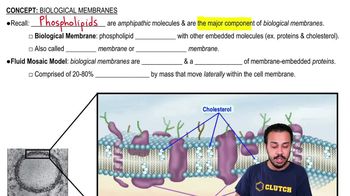
Biological Membranes

Ion Channels and Pumps

Ion channels and pumps are integral membrane proteins that facilitate the movement of ions across the plasma membrane. Channels allow passive transport following concentration gradients, while pumps actively transport ions against gradients using energy, often from ATP. This is crucial for maintaining ion balance and membrane potential.
추천 영상:
08:38
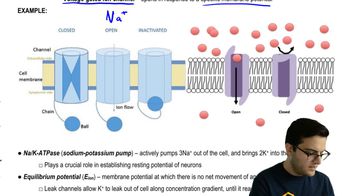
Ion Channels and Pumps

Carrier Proteins

Carrier proteins are specialized membrane proteins that transport specific molecules across the cell membrane. They bind to the molecule, undergo a conformational change, and release it on the other side. This process can be passive, following concentration gradients, or active, requiring energy input for transport against gradients.
추천 영상:
02:50
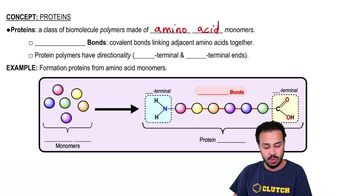
Proteins
관련 실천
교과서 질문

Which of the following groups of amino acid residues would likely be found in the portion that crosses the lipid bilayer?

a. Acidic

b. Basic

c. Polar uncharged

d. Nonpolar

2217
views
교과서 질문

Suppose a cell is placed in a solution with a high concentration of potassium and no sodium. How would the cellular sodium–potassium pump function in this environment?

a. It would stop moving ions across the membrane.

b. It would continue using ATP to pump sodium out of the cell and potassium into the cell.

c. It would move sodium and potassium ions across the membrane, but no ATP would be used.

d. It would reverse the direction of sodium and potassium ions to move them against their gradients.

2391
views
교과서 질문

Cooking oil lipids consist of long, unsaturated hydrocarbon chains. Would you expect these molecules to form membranes spontaneously? Why or why not? Describe, on a molecular level, how you would expect these lipids to behave in water.

2267
views
교과서 질문

What two conditions must be present for osmosis to occur? Integral membrane proteins are anchored in lipid bilayers.

2241
views
교과서 질문

In an experiment, you create two groups of liposomes in a solution containing 0.1 M NaCl—one made from red blood cell membranes and the other from frog egg cell membranes. When the liposomes are placed in water, those with red blood cell membranes burst more rapidly than those made from egg membranes. What could explain these results? Select True or False for each of the following statements.

a. T/F The red blood cell liposomes are more hypertonic relative to water than the frog egg liposomes.

b. T/F The red blood cell liposomes are more hypotonic relative to water than the frog egg liposomes.

c. T/F The red blood cell liposomes contain more aquaporins than the frog egg liposomes.

d. T/F The frog egg liposomes contain ion channels, which are not present in the red blood cell liposomes.

2207
views
교과서 질문

In terms of structure, how do channel proteins differ from carrier proteins?

2923
views