
Ch. 6 - Lipids, Membranes, and the First Cells
Freeman - Biological Science 8th Edition
Freeman8th EditionBiological ScienceISBN: 9780138276263당신이 사용하는 게 아니라요?교과서 변경
6장, 문제 3

What two conditions must be present for osmosis to occur? Integral membrane proteins are anchored in lipid bilayers.

검증된 단계별 안내
1
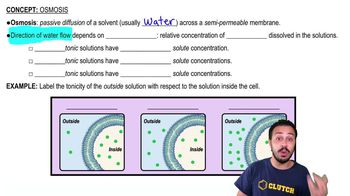
Understand the concept of osmosis: Osmosis is the movement of water molecules across a semipermeable membrane from an area of lower solute concentration to an area of higher solute concentration.
Identify the first condition for osmosis: There must be a semipermeable membrane that allows the passage of water molecules but restricts the movement of solute molecules.
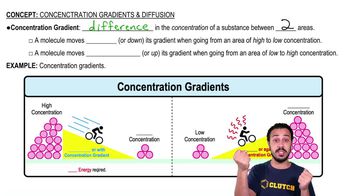
Identify the second condition for osmosis: There must be a concentration gradient of solute across the membrane, meaning there is a difference in solute concentration on either side of the membrane.
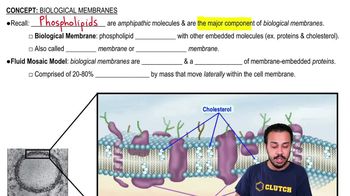
Recognize the role of integral membrane proteins: These proteins are embedded within the lipid bilayer and can facilitate the transport of molecules across the membrane, but they are not directly involved in osmosis.
Clarify the anchoring of integral membrane proteins: Integral membrane proteins are anchored in lipid bilayers through hydrophobic interactions between the protein and the lipid molecules, ensuring their stability and function within the membrane.

비슷한 문제에 대한 검증된 영상 답변:

이 영상 해법은 위 문제에 도움이 된다고 튜터들이 추천한 것입니다.
영상 길이:
1m

주요 개념

질문에 올바르게 답하기 위해 반드시 이해해야 하는 핵심 개념들은 다음과 같습니다.

Osmosis

Osmosis is the passive movement of water molecules across a semipermeable membrane from a region of lower solute concentration to a region of higher solute concentration. This process aims to equalize solute concentrations on both sides of the membrane, and it is crucial for maintaining cellular homeostasis.
추천 영상:
05:59
Osmosis

Semipermeable Membrane

A semipermeable membrane is a barrier that allows certain molecules or ions to pass through it while blocking others. In the context of osmosis, it permits the passage of water molecules but restricts solute movement, creating the conditions necessary for osmosis to occur.
추천 영상:
06:04
Biological Membranes

Concentration Gradient

A concentration gradient refers to the difference in the concentration of a solute across a space or a membrane. For osmosis to occur, there must be a concentration gradient of solutes across the semipermeable membrane, driving the movement of water to balance solute concentrations.
추천 영상:
04:51
Concentration Gradients and Diffusion
관련 실천
교과서 질문

How do the phospholipids in archaea differ from those in other cells?

a. They have tails made of unsaturated fatty acids instead of saturated fatty acids.

b. They do not contain hydrocarbon chains.

c. They have isoprenoid tails instead of fatty acid tails.

d. They have two hydrocarbon chains instead of three hydrocarbon chains.

2417
views
교과서 질문

Draw and label the plasma membrane of a cell that is placed in a solution with concentrations of calcium ions and lactose that are greater than those on the inside of the cell. Use arrows to show the relevant gradients and the activity of the following membrane proteins:

(1) A pump that exports protons

(2) A calcium channel

(3) A lactose carrier

2937
views
교과서 질문

Which of the following groups of amino acid residues would likely be found in the portion that crosses the lipid bilayer?

a. Acidic

b. Basic

c. Polar uncharged

d. Nonpolar

2306
views
교과서 질문

Cooking oil lipids consist of long, unsaturated hydrocarbon chains. Would you expect these molecules to form membranes spontaneously? Why or why not? Describe, on a molecular level, how you would expect these lipids to behave in water.

2309
views
교과서 질문

If a solution surrounding a cell is hypertonic relative to the inside of the cell, how will water move?

a. It will move into the cell via osmosis.

b. It will move out of the cell via osmosis.

c. It will not move, because equilibrium exists.

d. It will evaporate from the cell surface more rapidly.

4088
views