
Ch. 6 - Lipids, Membranes, and the First Cells
Freeman - Biological Science 8th Edition
Freeman8th EditionBiological ScienceISBN: 9780138276263당신이 사용하는 게 아니라요?교과서 변경
6장, 문제 2

If a solution surrounding a cell is hypertonic relative to the inside of the cell, how will water move?
a. It will move into the cell via osmosis.
b. It will move out of the cell via osmosis.
c. It will not move, because equilibrium exists.
d. It will evaporate from the cell surface more rapidly.

검증된 단계별 안내
1
Understand the concept of tonicity: A hypertonic solution has a higher concentration of solutes compared to the inside of the cell. This means the water concentration is lower outside the cell than inside.
Recall the principle of osmosis: Osmosis is the movement of water across a semipermeable membrane from an area of higher water concentration (lower solute concentration) to an area of lower water concentration (higher solute concentration).
Analyze the situation: Since the solution outside the cell is hypertonic, water concentration is higher inside the cell. Water will naturally move out of the cell to balance the concentration gradient.
Eliminate incorrect options: a) Water moving into the cell is incorrect because the solution is hypertonic. c) No movement due to equilibrium is incorrect because the concentrations are not balanced. d) Evaporation is unrelated to osmosis and tonicity.
Conclude the correct answer: Based on the principles of osmosis and the hypertonic environment, water will move out of the cell via osmosis.

비슷한 문제에 대한 검증된 영상 답변:

이 영상 해법은 위 문제에 도움이 된다고 튜터들이 추천한 것입니다.
영상 길이:
1m
도움이 되었나요?

주요 개념

질문에 올바르게 답하기 위해 반드시 이해해야 하는 핵심 개념들은 다음과 같습니다.

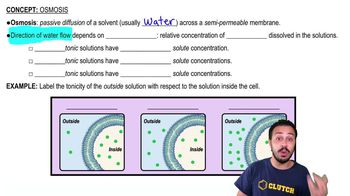
Osmosis

Osmosis is the passive movement of water molecules across a selectively permeable membrane from an area of lower solute concentration to an area of higher solute concentration. This process continues until equilibrium is reached, where the concentration of solutes is equal on both sides of the membrane. Understanding osmosis is crucial for predicting how water will move in response to different solute concentrations.
추천 영상:
05:59
Osmosis

Hypertonic Solution

A hypertonic solution has a higher concentration of solutes compared to the inside of a cell. When a cell is placed in a hypertonic solution, water will move out of the cell to balance the solute concentrations on both sides of the membrane. This movement can lead to cell shrinkage or crenation, which is important for understanding cellular responses to environmental changes.
추천 영상:
02:19
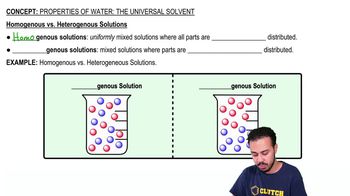
Homogenous vs. Heterogenous Solutions

Equilibrium

Equilibrium in biological systems refers to a state where the concentrations of solutes are equal on both sides of a membrane, resulting in no net movement of water. In the context of osmosis, achieving equilibrium means that the driving force for water movement has ceased. Recognizing when equilibrium is reached helps in understanding the dynamics of cellular environments and the effects of different solutions on cells.
추천 영상:
03:48
What is the Island Equilibrium Model?