
Ch. 8 - Energy and Enzymes: An Introduction to Metabolism
Freeman - Biological Science 8th Edition
Freeman8th EditionBiological ScienceISBN: 9780138276263당신이 사용하는 게 아니라요?교과서 변경
8장, 문제 3

How does pH affect enzyme-catalyzed reactions?
a. Protons serve as substrates for most reactions.
b. Energy stored in protons is used to drive endergonic reactions.
c. Proton concentration increases the kinetic energy of the reactants, enabling them to reach their transition state.
d. The concentration of protons affects an enzyme's folded structure and reactivity.

검증된 단계별 안내
1
Understand that enzymes are proteins that catalyze biochemical reactions, and their activity can be influenced by various factors, including pH.
Recognize that pH is a measure of the hydrogen ion (proton) concentration in a solution, which can affect the charge and shape of an enzyme.
Consider how changes in proton concentration can alter the ionic bonds and hydrogen bonds within an enzyme, potentially affecting its three-dimensional structure.
Analyze how the altered structure of an enzyme due to changes in pH can impact its active site, where substrate binding and catalysis occur.
Conclude that the concentration of protons (pH) affects an enzyme's folded structure and reactivity, influencing its ability to catalyze reactions effectively.

비슷한 문제에 대한 검증된 영상 답변:

이 영상 해법은 위 문제에 도움이 된다고 튜터들이 추천한 것입니다.
영상 길이:
2m
도움이 되었나요?

주요 개념

질문에 올바르게 답하기 위해 반드시 이해해야 하는 핵심 개념들은 다음과 같습니다.

Enzyme Structure and Function

Enzymes are proteins that catalyze biochemical reactions by lowering the activation energy required. Their function is highly dependent on their three-dimensional structure, which can be affected by environmental factors such as pH. Changes in pH can alter the ionic bonds and hydrogen bonds that maintain an enzyme's shape, potentially affecting its activity and efficiency.
추천 영상:
가이드 코스
02:32
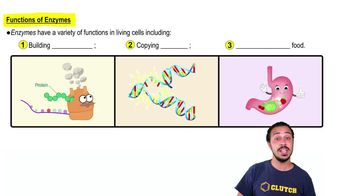
Functions of Enzymes

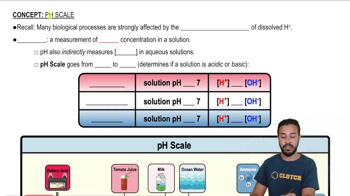
pH and Proton Concentration

pH is a measure of the hydrogen ion concentration in a solution, which can influence the charge and shape of molecules, including enzymes. Variations in pH can lead to changes in the protonation state of amino acids in enzymes, affecting their structure and reactivity. This is crucial for enzyme activity, as optimal pH levels are necessary for maintaining the correct enzyme conformation.
추천 영상:

Transition State and Reaction Kinetics

The transition state is a high-energy state that reactants must reach for a chemical reaction to occur. Enzymes facilitate the formation of the transition state by stabilizing it, thus speeding up the reaction. Proton concentration, influenced by pH, can affect the kinetic energy of reactants, impacting their ability to reach the transition state and the overall rate of enzyme-catalyzed reactions.
추천 영상:
가이드 코스
01:56
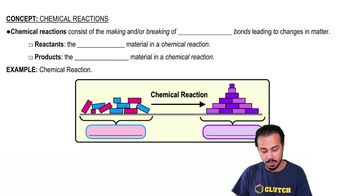
Chemical Reactions