Ch. 8 - Energy and Enzymes: An Introduction to Metabolism
Freeman - Biological Science 8th Edition
Freeman8th EditionBiological ScienceISBN: 9780138276263당신이 사용하는 게 아니라요?교과서 변경
8장, 문제 1

Which of the following correctly describe an exergonic reaction? Select True or False for each statement.
T/F The products have lower Gibbs free energy than the reactants.
T/F Activation energy is required for the reaction to proceed.
T/F The products always have lower entropy than the reactants.
T/F The reaction always occurs quickly.

검증된 단계별 안내
1
Understand the concept of an exergonic reaction: An exergonic reaction is a chemical reaction where the change in Gibbs free energy ( Δ G ) is negative, indicating that the reaction releases energy.
Evaluate the statement about Gibbs free energy: In an exergonic reaction, the products have lower Gibbs free energy than the reactants because energy is released during the reaction. This statement is true.
Consider the role of activation energy: Even though exergonic reactions release energy, they often require an initial input of energy to overcome the activation energy barrier. This statement is true.
Analyze the statement about entropy: Exergonic reactions do not necessarily result in products with lower entropy. Entropy can increase or decrease depending on the specific reaction. This statement is false.
Assess the speed of the reaction: The speed of an exergonic reaction is not determined solely by its exergonic nature. Other factors, such as the presence of catalysts, affect reaction speed. This statement is false.

비슷한 문제에 대한 검증된 영상 답변:

이 영상 해법은 위 문제에 도움이 된다고 튜터들이 추천한 것입니다.
영상 길이:
2m

주요 개념

질문에 올바르게 답하기 위해 반드시 이해해야 하는 핵심 개념들은 다음과 같습니다.

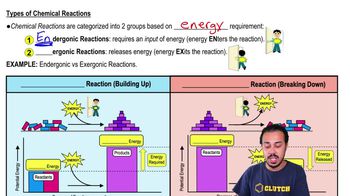
Exergonic Reaction

An exergonic reaction is a chemical process where the Gibbs free energy of the products is lower than that of the reactants, indicating that energy is released during the reaction. This release of energy makes the reaction spontaneous under constant temperature and pressure conditions.
추천 영상:
05:48
Types of Chemical Reactions

Gibbs Free Energy

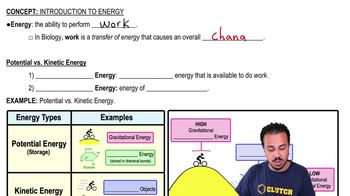
Gibbs free energy is a thermodynamic quantity that combines enthalpy and entropy to predict the feasibility of a reaction. In exergonic reactions, the change in Gibbs free energy (ΔG) is negative, signifying that the reaction releases energy and can occur spontaneously.
추천 영상:
04:58
Introduction to Energy

Activation Energy

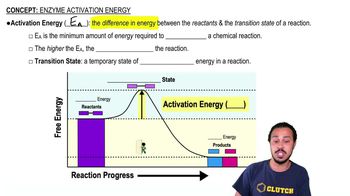
Activation energy is the minimum energy required to initiate a chemical reaction. Even in exergonic reactions, activation energy is needed to overcome the energy barrier and allow the reactants to transform into products, despite the overall energy release.
추천 영상:
04:18
Enzyme Activation Energy