
Ch. 8 - Energy and Enzymes: An Introduction to Metabolism
Freeman - Biological Science 8th Edition
Freeman8th EditionBiological ScienceISBN: 9780138276263당신이 사용하는 게 아니라요?교과서 변경
8장, 문제 7

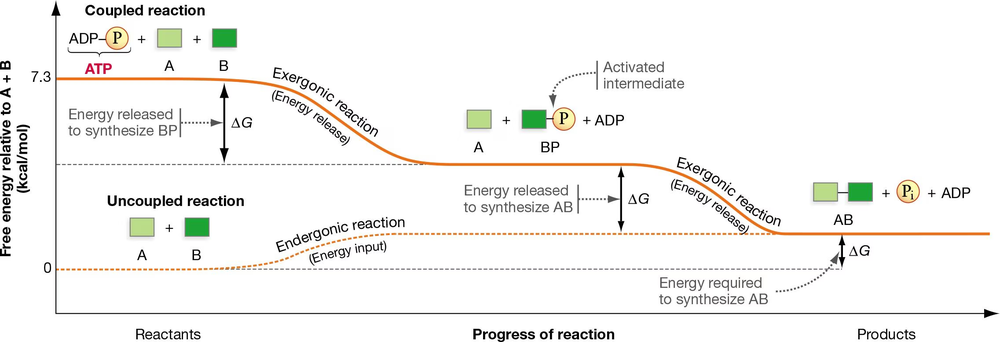
In Figure 8.10, the energetic coupling of substrate phosphorylation and an endergonic reaction are shown. If the hydrolysis of ATP releases 7.3 kcal of free energy, use the graph in this figure to estimate what you would expect the ∆G values to be for the uncoupled reaction and the two steps in the coupled reaction.
Graph showing energetic coupling of substrate phosphorylation with ATP hydrolysis, illustrating exergonic and endergonic reactions.

검증된 단계별 안내
1
Examine the graph to understand the energy changes involved in both the uncoupled and coupled reactions. The graph shows free energy changes relative to the reactants A and B.
Identify the uncoupled reaction, which is endergonic, meaning it requires an input of energy. The graph indicates that the free energy change (∆G) for the uncoupled reaction is positive, as energy is required to synthesize AB from A and B.
Note that the hydrolysis of ATP releases 7.3 kcal/mol of free energy, which is used to drive the coupled reaction. This energy release is depicted in the graph as the exergonic step where ATP is converted to ADP and inorganic phosphate (Pi).
In the coupled reaction, the energy released from ATP hydrolysis is used to form an activated intermediate (BP), which then reacts with A to form AB. The graph shows that the ∆G for the coupled reaction is negative, indicating that the reaction is exergonic overall.
Estimate the ∆G values for the uncoupled reaction and the two steps in the coupled reaction by analyzing the graph. The uncoupled reaction has a positive ∆G, while the coupled reaction has two steps: the first step (ATP hydrolysis) has a ∆G of -7.3 kcal/mol, and the second step (formation of AB) results in a net negative ∆G due to the energy released from ATP hydrolysis.

비슷한 문제에 대한 검증된 영상 답변:

이 영상 해법은 위 문제에 도움이 된다고 튜터들이 추천한 것입니다.
영상 길이:
1m
도움이 되었나요?

주요 개념

질문에 올바르게 답하기 위해 반드시 이해해야 하는 핵심 개념들은 다음과 같습니다.

Energetic Coupling

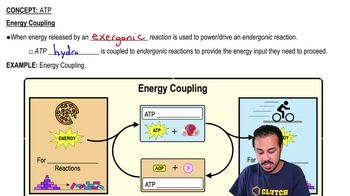
Energetic coupling refers to the process where an exergonic reaction (which releases energy) drives an endergonic reaction (which requires energy). In biological systems, ATP hydrolysis is a common exergonic reaction that provides the necessary energy to power various cellular processes, including the synthesis of biomolecules. This coupling allows cells to efficiently manage energy resources and perform work.
추천 영상:
04:57
Energy Coupling

Gibbs Free Energy (∆G)

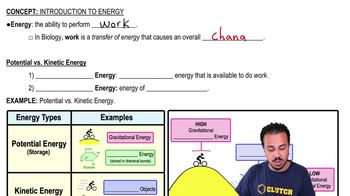
Gibbs Free Energy (∆G) is a thermodynamic quantity that indicates the spontaneity of a reaction. A negative ∆G value signifies that a reaction is exergonic and can occur spontaneously, while a positive ∆G indicates an endergonic reaction that requires energy input. Understanding ∆G is crucial for predicting the direction and feasibility of biochemical reactions, especially in the context of metabolic pathways.
추천 영상:
04:58
Introduction to Energy

Substrate Phosphorylation

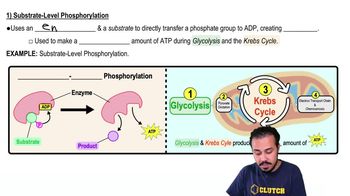
Substrate phosphorylation is a biochemical process where a phosphate group is transferred from a donor molecule (often ATP) to a substrate, resulting in the formation of a phosphorylated product. This process is essential in energy transfer within cells, as it often activates or deactivates enzymes and other proteins, thereby regulating metabolic pathways. It plays a key role in the coupling of reactions, as seen in the graph.
추천 영상:
03:00
Substrate-Level Phosphorylation
관련 실천
교과서 질문

You have discovered an enzyme that appears to function only when a particular sugar accumulates. Which of the following scenarios would you predict to be responsible for activating this enzyme?

a. The sugar cleaves the enzyme to form the active conformation.

b. The sugar is an allosteric regulatory molecule for the enzyme.

c. The sugar is a competitive inhibitor for the enzyme.

d. The sugar phosphorylates the enzyme to form the active conformation.

2154
views
교과서 질문

Using what you have learned about changes in Gibbs free energy, would you predict the ∆G value of catabolic reactions to be positive or negative? What about anabolic reactions? Justify your answers using the terms 'enthalpy' and 'entropy.'

2529
views
교과서 질문

If you were to expose glucose to oxygen on your lab bench, why would you not expect to see it burn as described by the reaction in Figure 8.6?

a. The reaction is endergonic and requires an input of energy.

b. The reaction is not spontaneous unless an enzyme is added.

c. The sugar must first be phosphorylated to increase its potential energy.

d. Activation energy is required for the sugar and oxygen to reach their transition state.

1911
views
교과서 질문

Explain the lock-and-key model of enzyme activity. What is incorrect about this model?

2746
views
교과서 질문

Explain how feedback inhibition regulates metabolic pathways.

1535
views
교과서 질문

Draw a chemical equation to represent the redox reaction that occurs when methane (CH4) burns in the presence of oxygen (O2). Identify the reactant that is reduced and the reactant that is oxidized. Of the four molecules that should be in your equation, point out the one that has bonds with the highest potential energy.

2812
views
1
rank