
Ch. 8 - Energy and Enzymes: An Introduction to Metabolism
Freeman - Biological Science 8th Edition
Freeman8th EditionBiological ScienceISBN: 9780138276263당신이 사용하는 게 아니라요?교과서 변경
8장, 문제 10

You have discovered an enzyme that appears to function only when a particular sugar accumulates. Which of the following scenarios would you predict to be responsible for activating this enzyme?
a. The sugar cleaves the enzyme to form the active conformation.
b. The sugar is an allosteric regulatory molecule for the enzyme.
c. The sugar is a competitive inhibitor for the enzyme.
d. The sugar phosphorylates the enzyme to form the active conformation.

검증된 단계별 안내
1
Understand the role of the sugar in enzyme activation. The problem suggests that the enzyme functions only when a particular sugar accumulates, indicating that the sugar plays a role in activating the enzyme.
Consider the concept of allosteric regulation. Allosteric regulation involves a molecule binding to a site other than the active site on an enzyme, causing a conformational change that affects enzyme activity. This is a common mechanism for enzyme activation.
Evaluate the option of the sugar being an allosteric regulatory molecule. If the sugar acts as an allosteric regulator, it would bind to the enzyme at a site other than the active site, inducing a conformational change that activates the enzyme.
Analyze the other options: a) Cleavage of the enzyme by the sugar would imply a permanent change, which is less common for reversible regulation. c) Competitive inhibition involves the sugar competing with the substrate for the active site, which would inhibit rather than activate the enzyme. d) Phosphorylation typically involves the addition of a phosphate group, not a sugar, to activate an enzyme.
Conclude that the most likely scenario is that the sugar acts as an allosteric regulatory molecule, as this aligns with the reversible and regulatory nature of enzyme activation in response to the accumulation of a specific molecule.

비슷한 문제에 대한 검증된 영상 답변:

이 영상 해법은 위 문제에 도움이 된다고 튜터들이 추천한 것입니다.
영상 길이:
4m
도움이 되었나요?

주요 개념

질문에 올바르게 답하기 위해 반드시 이해해야 하는 핵심 개념들은 다음과 같습니다.

Allosteric Regulation

Allosteric regulation involves the binding of a molecule at a site other than the enzyme's active site, causing a conformational change that affects enzyme activity. This can either activate or inhibit the enzyme. In the context of the question, if the sugar acts as an allosteric regulator, it would bind to the enzyme and induce a change that activates the enzyme.
추천 영상:
가이드 코스
03:31
Cell Cycle Regulation

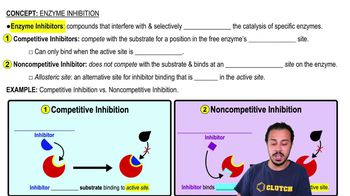
Competitive Inhibition

Competitive inhibition occurs when a molecule similar in structure to the substrate competes for binding at the enzyme's active site. This prevents the actual substrate from binding, thereby inhibiting enzyme activity. In the scenario described, if the sugar were a competitive inhibitor, it would not activate the enzyme but rather block its function.
추천 영상:
가이드 코스
05:03
Enzyme Inhibition

Enzyme Phosphorylation

Phosphorylation is a common post-translational modification where a phosphate group is added to an enzyme, often resulting in a functional change. This can activate or deactivate the enzyme. If the sugar phosphorylates the enzyme, it could potentially activate the enzyme by altering its conformation to a more active state.
추천 영상:
가이드 코스
03:00
Substrate-Level Phosphorylation