
Ch. 9 - Cellular Respiration and Fermentation
Freeman - Biological Science 8th Edition
Freeman8th EditionBiological ScienceISBN: 9780138276263당신이 사용하는 게 아니라요?교과서 변경
9장, 문제 3

After glucose is fully oxidized by glycolysis, pyruvate processing, and the citric acid cycle, where is most of its energy stored?

검증된 단계별 안내
1
Identify the main stages of glucose oxidation: Glycolysis, Pyruvate Processing, and the Citric Acid Cycle.
Understand that during these stages, glucose is broken down and its energy is transferred to other molecules.
Recognize that the energy from glucose is primarily stored in the form of high-energy electron carriers (NADH and FADH2) and a small amount in ATP.
Note that NADH and FADH2 carry electrons to the electron transport chain, where most of the ATP is produced during oxidative phosphorylation.
Conclude that after the complete oxidation of glucose, most of its energy is stored in the high-energy electron carriers, NADH and FADH2, which are utilized in the electron transport chain to produce ATP.

비슷한 문제에 대한 검증된 영상 답변:

이 영상 해법은 위 문제에 도움이 된다고 튜터들이 추천한 것입니다.
영상 길이:
1m
도움이 되었나요?

주요 개념

질문에 올바르게 답하기 위해 반드시 이해해야 하는 핵심 개념들은 다음과 같습니다.

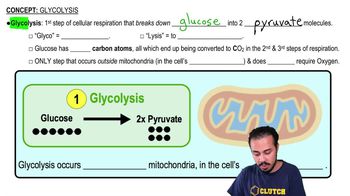
Glycolysis

Glycolysis is the first step in the breakdown of glucose, occurring in the cytoplasm of cells. It converts one molecule of glucose into two molecules of pyruvate, producing a net gain of two ATP and two NADH molecules. This process is anaerobic and sets the stage for further energy extraction in aerobic respiration.
추천 영상:

Citric Acid Cycle

The Citric Acid Cycle, also known as the Krebs cycle, takes place in the mitochondria and is a key component of cellular respiration. It processes acetyl-CoA, derived from pyruvate, to produce energy-rich electron carriers, NADH and FADH2, along with ATP. This cycle is crucial for the complete oxidation of glucose and the release of stored energy.
추천 영상:

Electron Transport Chain

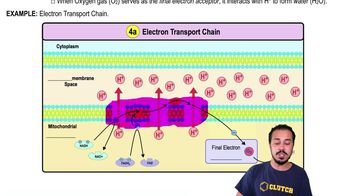
The Electron Transport Chain (ETC) is the final stage of aerobic respiration, located in the inner mitochondrial membrane. It utilizes the NADH and FADH2 produced in earlier stages to create a proton gradient, driving ATP synthesis through oxidative phosphorylation. Most of the energy from glucose oxidation is stored in the form of ATP generated during this process.
추천 영상:
가이드 코스
07:41
Electron Transport Chain