
Ch. 9 - Cellular Respiration and Fermentation
Freeman - Biological Science 8th Edition
Freeman8th EditionBiological ScienceISBN: 9780138276263당신이 사용하는 게 아니라요?교과서 변경
9장, 문제 4

Which of the following correctly describe the fermentation pathway? Select True or False for each statement.
T/FIt includes a reaction that oxidizes NADH to NAD+.
T/FIt synthesizes ATP by substrate-level phosphorylation.
T/FIt includes a reaction that reduces NAD+ to NADH.
T/FIt synthesizes electron acceptors, so that cellular respiration can continue.

검증된 단계별 안내
1
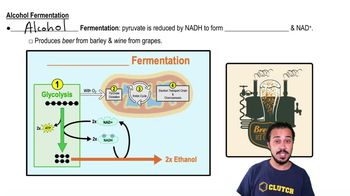
Understand that fermentation is an anaerobic process that allows glycolysis to continue by regenerating NAD+ from NADH.
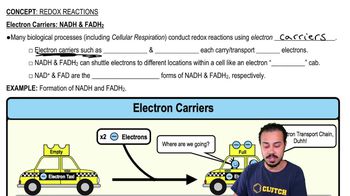
Recognize that during fermentation, NADH is oxidized to NAD+ to ensure a continuous supply of NAD+ for glycolysis. This statement is True.
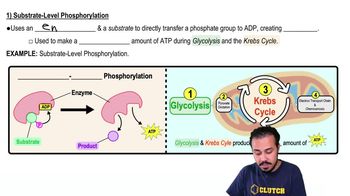
Identify that ATP is synthesized during fermentation through substrate-level phosphorylation, which occurs during glycolysis. This statement is True.
Note that fermentation does not include a reaction that reduces NAD+ to NADH; instead, it oxidizes NADH to NAD+. This statement is False.
Understand that fermentation does not synthesize electron acceptors for cellular respiration; it provides a way to regenerate NAD+ without oxygen. This statement is False.

비슷한 문제에 대한 검증된 영상 답변:

이 영상 해법은 위 문제에 도움이 된다고 튜터들이 추천한 것입니다.
영상 길이:
2m
도움이 되었나요?

주요 개념

질문에 올바르게 답하기 위해 반드시 이해해야 하는 핵심 개념들은 다음과 같습니다.

Fermentation Pathway

Fermentation is a metabolic process that converts sugar to acids, gases, or alcohol in the absence of oxygen. It allows cells to regenerate NAD+ from NADH, enabling glycolysis to continue producing ATP. Unlike cellular respiration, fermentation does not involve the electron transport chain or oxidative phosphorylation.
추천 영상:
가이드 코스
02:02
Alcohol Fermentation

NAD+/NADH Cycle

NAD+ and NADH are crucial coenzymes in cellular metabolism. During glycolysis and fermentation, NAD+ is reduced to NADH, capturing electrons. Fermentation pathways regenerate NAD+ by oxidizing NADH, ensuring a continuous supply for glycolysis, which is essential for ATP production in anaerobic conditions.
추천 영상:
가이드 코스
05:22
Electron Carriers: NADH & FADH2

Substrate-Level Phosphorylation

Substrate-level phosphorylation is a method of ATP synthesis that occurs directly in metabolic pathways like glycolysis and fermentation. It involves the transfer of a phosphate group from a phosphorylated intermediate to ADP, forming ATP. This process is distinct from oxidative phosphorylation, which occurs in the mitochondria during aerobic respiration.
추천 영상:
가이드 코스
03:00
Substrate-Level Phosphorylation