 뒤로
뒤로Activity-Based Costing (ABC): Concepts and Applications
스터디 가이드 - 스마트 노트
 자료에 맞춘 맞춤형 노트, 핵심 정의, 예시, 맥락을 확장해 제공합니다.
Activity-Based Costing (ABC)
Introduction to Activity-Based Costing
Activity-Based Costing (ABC) is a method used to assign indirect costs to products and services based on the specific activities they require. This approach provides a more accurate allocation of overhead costs compared to traditional costing methods, especially in organizations that produce a variety of products or offer diverse services.
Goal 1: Identify the major activities that produce costs within the organization.
Goal 2: Assign indirect costs to products or services based on the activities they consume.
Application: ABC is particularly useful for companies with complex production processes or multiple product lines.
Managers use ABC to:
Make informed decisions, such as setting prices.
Change business processes by eliminating unnecessary activities.
Improve performance by reducing costs or increasing sales.
Enterprise Resource Planning (ERP) Systems
Implementing ABC requires collecting a wide range of data, which is facilitated by Enterprise Resource Planning (ERP) systems. An ERP system is an integrated management information system that spans the entire organization, including manufacturing, supplier management, customer relationship management, and accounting.
Purpose: To provide timely information for strategic and operational decision-making.
Drawback: ERP systems are expensive to implement and maintain, so managers must carefully weigh the costs and benefits.
When ABC Is Not Appropriate
ABC is not suitable for every company. It may not be worth implementing if:
The system is too complex for the organization's needs.
The cost of implementation outweighs the benefits.
The primary focus of ABC remains the accurate assignment of indirect costs based on activities.
Stages of Cost Assignment in ABC
Overview of the Two-Stage Allocation Process
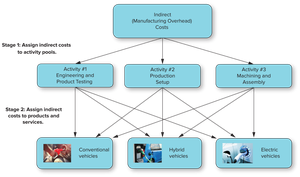
The ABC method assigns costs in two main stages:
Stage 1: Indirect costs are assigned to activity pools.
Stage 2: Indirect costs are allocated from the activity pools to individual products or services based on cost drivers.
Stage 1: Identify and Classify Activities
The first step is to identify the major activities performed by the organization. These activities are then classified into a hierarchy:
Facility-Level Activities: Support the entire company (e.g., administrative support, facility maintenance, corporate advertising).
Product-Level Activities: Support specific product lines (e.g., product design, product testing, marketing, and documentation).
Batch-Level Activities: Performed for groups of units or customers (e.g., material handling, batch-specific packaging, production setup).
Unit-Level Activities: Performed for each individual unit (e.g., direct materials, unit-specific inspection, machine use).
Stage 2: Form Activity Pools and Assign Indirect Costs
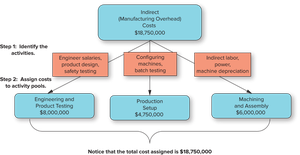
After identifying activities, similar activities are grouped into activity pools. Indirect costs are then assigned to each pool based on observable measures, such as labor hours or machine hours.
Costs that are shared among activities must be allocated using logical and measurable bases.
Each activity pool is associated with a cost driver that reflects the cause of the costs in that pool.
Examples of Activity Pools and Cost Assignment
Activity Pool | Examples of Activities | Assigned Indirect Costs |
|---|---|---|
Engineering and Product Testing | Engineer salaries, product design, safety testing | $8,000,000 |
Production Setup | Configuring machines, batch testing | $4,750,000 |
Machining and Assembly | Indirect labor, power, machine depreciation | $6,000,000 |
Total Indirect (Manufacturing Overhead) Costs: $18,750,000
Summary of the ABC Process
Identify and classify activities performed by the organization.
Group activities into activity pools and assign indirect costs to each pool.
Select appropriate cost drivers for each activity pool.
Allocate indirect costs to products or services based on their usage of activities (measured by cost drivers).
Formula for Allocating Indirect Costs Using ABC:
Additional info: ABC provides more accurate product costing, which supports better pricing, product mix, and process improvement decisions.
