 뒤로
뒤로Business Calculus Study Guide: First Derivative Test & Local Extrema
스터디 가이드 - 스마트 노트
 자료에 맞춘 맞춤형 노트, 핵심 정의, 예시, 맥락을 확장해 제공합니다.
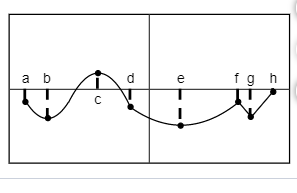
Q1. Given the graph below, answer the following:
A) Identify the intervals on which is increasing; Identify the interval on which .
B) Identify the intervals on which is decreasing; Identify the interval on which .
C) Find the coordinate where has a local minimum.
D) Find the coordinate where has a local maximum.
Background
Topic: First Derivative Test & Local Extrema
This question tests your understanding of how the first derivative relates to increasing/decreasing behavior and how to identify local minima and maxima from a graph.
Key Terms and Formulas:
Increasing Interval: is increasing where .
Decreasing Interval: is decreasing where .
Local Minimum: A point where changes from decreasing to increasing.
Local Maximum: A point where changes from increasing to decreasing.
Step-by-Step Guidance
Examine the graph and identify the segments where the curve is moving upwards (increasing) and downwards (decreasing).
For each interval, note the corresponding values (such as between points a, b, c, etc.).
Recall that on increasing intervals and on decreasing intervals.
Look for turning points where the graph switches from increasing to decreasing (local maxima) or decreasing to increasing (local minima).
Mark the coordinates of these turning points, but do not state the final values yet.
Try solving on your own before revealing the answer!
Final Answer:
A) is increasing on intervals (b, c), (e, g).
B) is decreasing on intervals (a, b), (c, e), (g, h).
C) Local minimum at .
D) Local maximum at and .
These answers are based on the direction of the curve and the turning points visible in the graph.
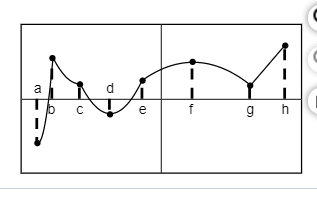
Q2. Given the graph below, answer the following:
A) Find the intervals on which is increasing.
B) Find the intervals on which is decreasing.
C) Find the relative minimum or local minimum.
D) Find the relative maximum or local maximum.
Background
Topic: First Derivative Test & Local Extrema
This question also tests your ability to interpret a graph and apply the first derivative test to identify increasing/decreasing intervals and local extrema.
Key Terms and Formulas:
Increasing Interval: is increasing where .
Decreasing Interval: is decreasing where .
Local Minimum: A point where changes from decreasing to increasing.
Local Maximum: A point where changes from increasing to decreasing.
Step-by-Step Guidance
Analyze the graph to determine where the function is rising (increasing) and falling (decreasing).
Identify the intervals corresponding to these behaviors (such as between points a, b, c, etc.).
Locate the points where the graph changes direction—these are potential local minima and maxima.
Record the coordinates of these turning points, but do not state the final values yet.
Try solving on your own before revealing the answer!
Final Answer:
A) is increasing on intervals (b, d), (e, g), (g, h).
B) is decreasing on intervals (a, b), (d, e), (f, g).
C) Local minimum at and .
D) Local maximum at , , and .
The intervals and points are determined by observing where the graph rises and falls, and where it changes direction.
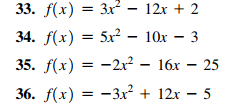
Q3. For the following quadratic functions, find the vertex (maximum or minimum point):
33.
34.
35.
36.
Background
Topic: Quadratic Functions & Vertex Calculation
This question tests your ability to find the vertex of a quadratic function, which is the maximum or minimum point depending on the sign of the leading coefficient.
Key Terms and Formulas:
Vertex of a Quadratic: The vertex is found using and for .
Minimum/Maximum: If , the vertex is a minimum; if , the vertex is a maximum.
Step-by-Step Guidance
For each function, identify , , and in the standard form .
Calculate for each function.
Plug back into the function to find .
Determine whether the vertex is a minimum or maximum based on the sign of .
Set up the calculation for , but do not compute the final value yet.
Try solving on your own before revealing the answer!
Final Answer:
33. Vertex at , minimum point.
34. Vertex at , minimum point.
35. Vertex at , maximum point.
36. Vertex at , maximum point.
Each vertex is calculated using and . The sign of determines if it's a minimum or maximum.
