 뒤로
뒤로Continuity and Sign Charts in Business Calculus 2.3
스터디 가이드 - 스마트 노트
 자료에 맞춘 맞춤형 노트, 핵심 정의, 예시, 맥락을 확장해 제공합니다.
Continuity and the Derivative
Continuity of Functions
Continuity is a fundamental concept in calculus, describing whether a function can be drawn without lifting the pen from the paper. A function is continuous at a point if its graph is unbroken at that point. More formally, a function f is continuous at x = c if the following three conditions are met:
1. f(c) is defined
2. \( \lim_{x \to c} f(x) \) exists
3. \( \lim_{x \to c} f(x) = f(c) \)
If any of these conditions fail, the function is discontinuous at x = c.
Examples of Continuity and Discontinuity
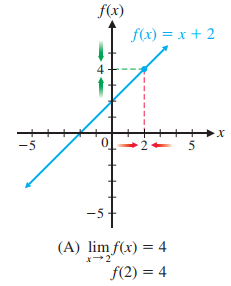
Continuous Function Example: The function \( f(x) = x + 2 \) is continuous for all real numbers. At x = 2, \( \lim_{x \to 2} f(x) = 4 \) and \( f(2) = 4 \), so all conditions for continuity are satisfied.
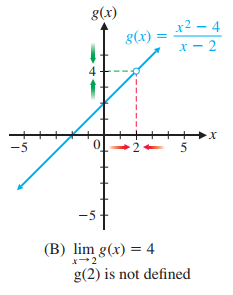
Discontinuous Function Example: The function \( g(x) = \frac{x^2 - 4}{x - 2} \) is not defined at x = 2 (division by zero), but \( \lim_{x \to 2} g(x) = 4 \). Since \( g(2) \) is not defined, the function is discontinuous at x = 2.
Types of Discontinuity
Discontinuities can occur for several reasons:
Removable Discontinuity: The limit exists, but the function is not defined at that point.
Jump Discontinuity: The left and right limits exist but are not equal.
Infinite Discontinuity: The function approaches infinity at the point.
When analyzing a graph, check each condition of continuity at points of interest to determine the type of discontinuity.
Continuity of Functions Defined by Equations
To determine continuity for functions given by equations, apply the definition at the indicated point. For polynomials and rational functions, continuity is determined by the domain:
Polynomial functions are continuous everywhere.
Rational functions are continuous everywhere except where the denominator is zero.
Radical functions with even indices are continuous where the radicand is non-negative.
General Continuity Properties
If two functions are continuous on the same interval, their sum, difference, product, and quotient (except where the denominator is zero) are also continuous on that interval.
Constant function: \( f(x) = k \) is continuous for all x.
Power function: \( f(x) = x^n \) (n positive integer) is continuous for all x.
Polynomial: Continuous for all x.
Rational function: Continuous except where denominator is zero.
Sign Charts and Solving Inequalities
Partition Numbers and Intervals
A partition number for a function f is a real number x where f is discontinuous or f(x) = 0. Partition numbers divide the real number line into open intervals where the function does not change sign.
Procedure: Constructing Sign Charts
Find all partition numbers: Solve for x where f is discontinuous or f(x) = 0.
Plot partition numbers on a real number line, dividing it into intervals.
Select a test number in each interval and evaluate f(x) to determine the sign.
Construct a sign chart to summarize the sign of f(x) on each interval.
Theorem: Sign Properties on an Interval
If f is continuous on (a, b) and f(x) ≠ 0 for all x in (a, b), then f(x) is either always positive or always negative on (a, b).
Example: Solving an Inequality Using a Sign Chart
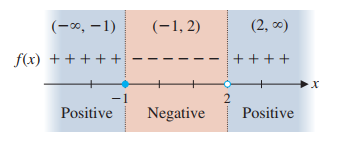
Suppose f(x) is undefined at x = 2 and zero at x = -1. These are the partition numbers. The real number line is divided into three intervals: (-∞, -1), (-1, 2), and (2, ∞). By evaluating f(x) at test points in each interval, we determine the sign of f(x):
f(x) > 0 for x < -1 and x > 2
f(x) < 0 for -1 < x < 2
Example: Positive Profit in Business
A bakery's annual profit is modeled by P(x) = 6x - 0.001x^2 - 5000. To find when profit is positive, set P(x) = 0 and solve for x:
\( P(x) = -0.001(x - 1000)(x - 5000) \)
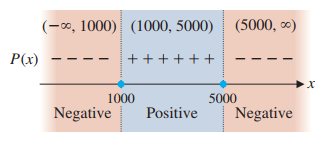
Partition numbers: x = 1000 and x = 5000
Test points in each interval show that profit is positive for 1000 < x < 5000. Thus, the bakery should produce between 1000 and 5000 loaves to make a profit.
Summary Table: Continuity Properties of Common Functions
Function Type | Continuity |
|---|---|
Constant | All real numbers |
Polynomial | All real numbers |
Rational | All real numbers except where denominator is zero |
Radical (even index) | Where radicand is non-negative |
