 뒤로
뒤로Infinite Limits and Limits at Infinity: Study Notes for Business Calculus 2.2
스터디 가이드 - 스마트 노트
 자료에 맞춘 맞춤형 노트, 핵심 정의, 예시, 맥락을 확장해 제공합니다.
Infinite Limits and Limits at Infinity
Infinite Limits
Infinite limits describe the behavior of functions that become unbounded as the input approaches a specific value. This concept is fundamental in understanding discontinuities and vertical asymptotes in calculus.
Infinite Limit: If the values of f(x) grow without bound as x approaches a certain value a, the limit is said to be infinite.
Vertical Asymptote: A vertical line x = a where the function increases or decreases without bound as x approaches a.
Discontinuity: The function is discontinuous at the point where the infinite limit occurs, and f(a) does not exist.
Example: Consider the function . As x approaches 1 from the right, f(x) increases without bound. As x approaches 1 from the left, f(x) decreases without bound.
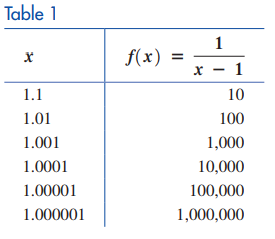
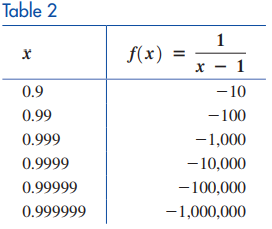
Key Point: Since and are not real numbers, these limits do not exist in the traditional sense, but the notation is used to describe the behavior.
Infinity Symbol (): Used to indicate positive growth without bound.
Negative Infinity Symbol (): Used to indicate negative growth without bound.
Definition: Infinite Limits and Vertical Asymptotes
An infinite limit occurs when the values of a function increase or decrease without bound as the input approaches a specific value. A vertical asymptote is the line where this behavior occurs.
Polynomial Functions: Do not have vertical asymptotes.
Rational Functions: May have vertical asymptotes at zeros of the denominator.
Theorem 1: Locating Vertical Asymptotes of Rational Functions
For a rational function , a vertical asymptote occurs at each zero of where is nonzero.
Example: For , the denominator factors as , so vertical asymptotes may occur at and .
Indeterminate Form: If both numerator and denominator are zero at a point, further analysis is needed.
Limits at Infinity
Limits at infinity describe the behavior of functions as the input grows arbitrarily large in the positive or negative direction. Horizontal asymptotes are used to describe this behavior.
Limit at Infinity: describes the behavior as x increases without bound.
Horizontal Asymptote: A horizontal line y = L that the function approaches as x goes to infinity or negative infinity.
Theorem 2: Limits of Power Functions at Infinity
For a power function , the limit as x approaches infinity depends on the degree and sign of n.
Example: Limit of a Polynomial Function at Infinity
Let . The behavior for large values of x is dominated by the highest degree term, .
Theorem 3: Limits of Polynomial Functions at Infinity
A polynomial of degree 0 (constant) has a limit equal to its constant value as x approaches infinity or negative infinity.
Polynomials of degree 1 or greater do not have horizontal asymptotes.
End Behavior of a Function
The end behavior of a function is described by its limits as x approaches infinity and negative infinity.
Right End Behavior:
Left End Behavior:
Example: Find the End Behavior of a Function
For , the end behavior is determined by the term .
Theorem 4: Limits of Rational Functions at Infinity/Horizontal Asymptotes
For rational functions, horizontal asymptotes are determined by the degrees of the numerator and denominator.
If degree of numerator < degree of denominator: is a horizontal asymptote.
If degree of numerator = degree of denominator: , where and are leading coefficients.
If degree of numerator > degree of denominator: No horizontal asymptote.
Example: Finding Horizontal Asymptotes
For , the x-axis () is a horizontal asymptote.
For , is a horizontal asymptote.
For , there is no horizontal asymptote.
Application Example: End Behavior in Business Context
A newly released smart-phone operating system gives users an update notice when they download a new app. The frequency of update notices as the number of downloads increases can be modeled by a function whose end behavior describes the long-term trend.
Tables: Infinite Limits
The following tables illustrate the behavior of as x approaches 1 from the right and left:
x (right of 1) | f(x) |
|---|---|
1.1 | 10 |
1.01 | 100 |
1.001 | 1,000 |
1.0001 | 10,000 |
1.00001 | 100,000 |
1.000001 | 1,000,000 |
x (left of 1) | f(x) |
|---|---|
0.9 | -10 |
0.99 | -100 |
0.999 | -1,000 |
0.9999 | -10,000 |
0.99999 | -100,000 |
0.999999 | -1,000,000 |
Interpretation: As x approaches 1 from the right, f(x) increases without bound (). As x approaches 1 from the left, f(x) decreases without bound ().
