 뒤로
뒤로Limits and the Derivative: Average and Instantaneous Rates of Change 2.4
스터디 가이드 - 스마트 노트
 자료에 맞춘 맞춤형 노트, 핵심 정의, 예시, 맥락을 확장해 제공합니다.
Limits and the Derivative
Introduction to Derivatives
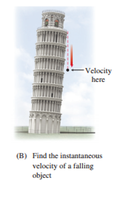
The concept of limits is fundamental in calculus and helps solve two primary problems: finding the equation of the tangent line to a function at a specified point, and determining the instantaneous velocity of an object in motion. These problems are central to understanding how functions change and are foundational in business calculus.
Tangent Line: The tangent line represents the instantaneous rate of change of a function at a specific point.
Instantaneous Velocity: The velocity at a particular moment, as opposed to the average velocity over an interval.
Average Rate of Change
The average rate of change of a function over an interval is calculated by dividing the change in the function's value by the change in the input. In business applications, this often represents average velocity or average revenue per unit.
Definition: The average rate of change is given by the difference quotient:
Example: On a trip, if you pass mile marker 120 at 9 AM and mile marker 250 at 11 AM, the average velocity is:
mph
Application: In business, the average rate of change can represent the average increase in revenue per unit produced.
Example: Revenue Analysis
Consider a company manufacturing plastic planter boxes. The revenue function is for . To find the change in revenue as production increases from 100 to 400 planters:
Change in Revenue:
Result: Revenue increases by $3,000 when production increases from 100 to 400 planters.
Average Rate of Change: dollars per planter.
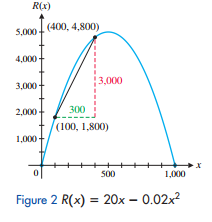
The secant line connecting the points and on the graph represents the average rate of change in revenue between these points.
Example: Velocity of a Falling Object
For a small steel ball dropped from a tower, the distance fallen in seconds is given by . The positions at seconds are:
At : feet
At : feet
At : feet
At : feet
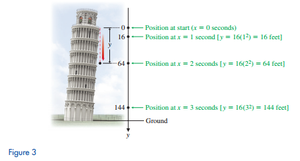
The average velocity from to seconds is:
feet per second
For a general interval from to seconds, the average rate of change is:
As approaches zero, this expression approaches the instantaneous velocity at seconds.
Instantaneous Rate of Change and the Derivative
The instantaneous rate of change is the value the average rate of change approaches as the interval becomes infinitesimally small. In calculus, this is formalized as the derivative of a function.
Definition: The derivative of at is:
Interpretations:
Slope of the tangent line to the graph at
Instantaneous rate of change of with respect to
Velocity if represents position as a function of time
Secant and Tangent Lines
A secant line passes through two points on a function's graph and its slope represents the average rate of change. A tangent line touches the graph at a single point and its slope represents the instantaneous rate of change at that point.
As the second point on the secant line approaches the first, the secant line becomes the tangent line.
The slope of the tangent line is the derivative at that point.
Procedure: Four-Step Process for Finding the Derivative
To find the derivative of a function , follow these steps:
Find .
Compute .
Form the difference quotient .
Take the limit as .
Example: For :
Step 1:
Step 2:
Step 3:
Step 4:
Nonexistence of the Derivative
The derivative at exists only if the limit defining the derivative exists at that point. If the limit does not exist, the function is said to be nondifferentiable at .
Key Point: Not all functions are differentiable everywhere; points of nondifferentiability include corners, cusps, and discontinuities.
