 뒤로
뒤로Logarithmic Functions: Definitions, Properties, and Applications 1.6
스터디 가이드 - 스마트 노트
 자료에 맞춘 맞춤형 노트, 핵심 정의, 예시, 맥락을 확장해 제공합니다.
Logarithmic Functions
Inverse Functions and One-to-One Functions
Logarithmic functions are defined as the inverse of exponential functions. Understanding inverse functions requires knowledge of one-to-one functions, which are functions where each range value corresponds to exactly one domain value.
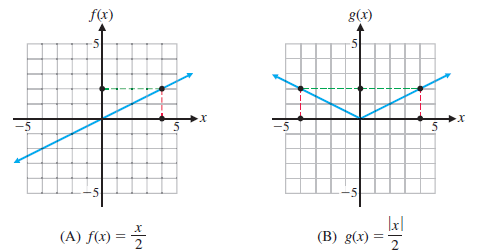
One-to-One Function: A function f is one-to-one if for every value in the range, there is exactly one corresponding value in the domain.
Continuous Increasing/Decreasing Functions: Any continuous function that is either strictly increasing or strictly decreasing for all domain values is one-to-one.
Inverse Function: If f is one-to-one, its inverse is formed by interchanging the independent and dependent variables. If (a, b) is on the graph of f, then (b, a) is on the graph of its inverse.
Non-One-to-One Functions: Functions that increase for some domain values and decrease for others are not one-to-one and do not have inverses.
Definition and Properties of Logarithmic Functions
The logarithmic function is the inverse of the exponential function. For base b where b > 0 and b ≠ 1, the logarithmic function is defined as:
Logarithmic Form:
Exponential Form:
Interpretation: is the exponent to which b must be raised to obtain x.
Domain: All positive real numbers.
Range: All real numbers.
Graphing Logarithmic and Exponential Functions
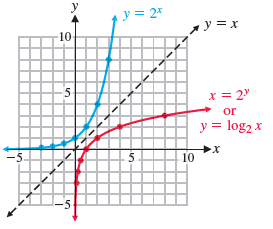
The graph of a logarithmic function is the reflection of the graph of its corresponding exponential function across the line y = x. The domain of the logarithmic function is restricted to positive values, so its graph lies entirely to the right of the y-axis.
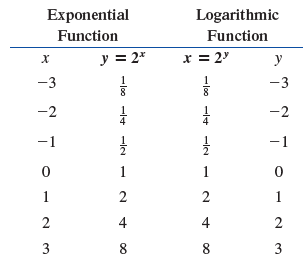
Converting Between Logarithmic and Exponential Forms
Converting between logarithmic and exponential forms is a fundamental skill:
Logarithmic to Exponential:
Exponential to Logarithmic:
Solving Logarithmic Equations
Logarithmic equations can be solved by converting them to exponential form:
Example 1: Solve for b. Convert to exponential: .
Example 2: Solve for x. Convert to exponential: .
Properties of Logarithmic Functions
Logarithmic functions have several important properties, including:
Product Rule:
Quotient Rule:
Power Rule:
Common and Natural Logarithms
Two bases are used almost exclusively in mathematics:
Common Logarithm: Base 10, written as .
Natural Logarithm: Base e, written as .
Most calculators have dedicated keys for LOG and LN.
Calculator Evaluation of Logarithms
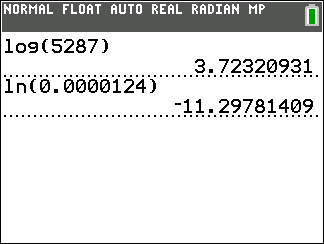
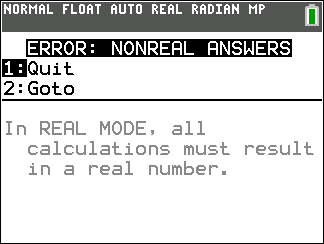
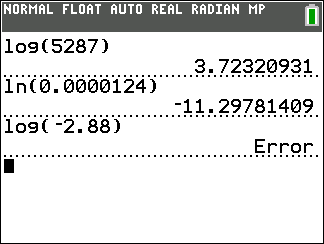
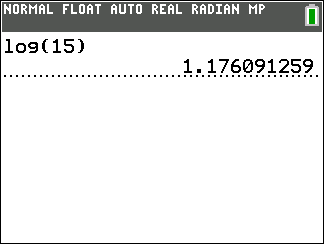
Logarithms can be evaluated using calculators. Only positive values are in the domain of logarithmic functions; negative values result in errors.
Example:
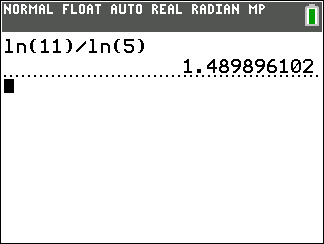
Example:
Example: results in an error.
Solving Logarithmic and Exponential Equations Using Calculators
Calculators can be used to solve logarithmic and exponential equations efficiently.
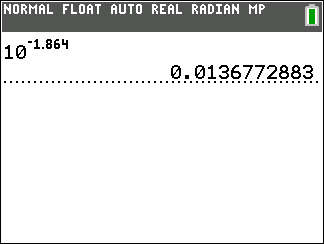
Example: Solve for x. Convert to exponential:
Example: Solve for x. Convert to exponential:
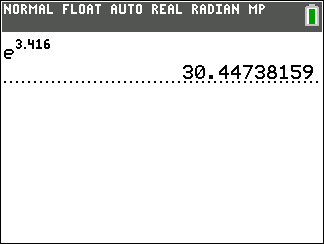
Example: Solve for x. Take logarithm:
Example: Solve for x. Take natural logarithm:
Applications of Logarithms: Doubling Time
Logarithms are used to solve problems involving exponential growth, such as finding the doubling time for investments.
Doubling Time Formula: For compound interest, , set to find doubling time.
Example: If , , take natural logarithm:
Logarithmic Regression
Logarithmic regression is used to model data sets where the dependent variable increases slowly as the independent variable increases. The best fit logarithmic function is often of the form .
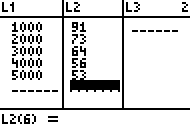
Example: Price-demand data for a product can be modeled using logarithmic regression.
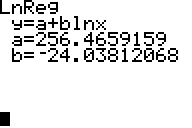
Enter data into lists on a calculator and use the LnReg function to find the best fit equation.
Regression Equation:
Prediction: To estimate price for , evaluate
Exponential Function | Logarithmic Function | ||
|---|---|---|---|
x | y = 2^x | x = 2^y | y |
-3 | 1/8 | 1/8 | -3 |
-2 | 1/4 | 1/4 | -2 |
-1 | 1/2 | 1/2 | -1 |
0 | 1 | 1 | 0 |
1 | 2 | 2 | 1 |
2 | 4 | 4 | 2 |
3 | 8 | 8 | 3 |
