 뒤로
뒤로Marginal Analysis in Business and Economics: Marginal Cost, Revenue, and Profit 2.7
스터디 가이드 - 스마트 노트
 자료에 맞춘 맞춤형 노트, 핵심 정의, 예시, 맥락을 확장해 제공합니다.
Marginal Analysis in Business and Economics
Definition of Marginal Cost, Revenue, and Profit
Marginal analysis is a fundamental concept in business calculus, used to determine the effect of producing one additional unit of a product. The marginal cost, revenue, and profit are defined as the derivatives of their respective total functions with respect to the number of units produced.
Total Cost (C(x)): The total expense incurred in producing x units.
Marginal Cost (C'(x)): The derivative of the total cost function, representing the instantaneous rate of change of cost with respect to production level.
Total Revenue (R(x)): The total income from selling x units.
Marginal Revenue (R'(x)): The derivative of the total revenue function, representing the instantaneous rate of change of revenue with respect to production level.
Total Profit (P(x)): The difference between total revenue and total cost, P(x) = R(x) - C(x).
Marginal Profit (P'(x)): The derivative of the profit function, or P'(x) = R'(x) - C'(x).
Formulas:
= Marginal Cost
= Marginal Revenue
= Marginal Profit
Marginals and Derivatives
The marginal cost, revenue, or profit is the instantaneous rate of change of the respective function with respect to the number of units produced. This is mathematically represented by the derivative.
Marginal Cost and Exact Cost
The exact additional cost of producing one more item is given by the difference:
Exact additional cost:
Exact additional revenue:
Exact additional profit:
The marginal cost function approximates the exact cost of producing the (x+1)st item.
Example: Cost Analysis
Given:
(A) Marginal cost function:
(B) Marginal cost at :
Interpretation: At 500 tanks per week, the cost is increasing at $40 per tank. The 501st tank should cost about $40 to make.
(D) Exact cost of the 501st tank:
Theorem: Marginal Cost and Exact Cost
If is the total cost of producing items, then the marginal cost function approximates the exact cost of producing the st item:
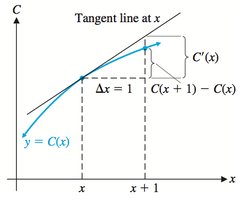
Example: Compare Exact Cost and Marginal Cost
Given:
Exact cost of 121st bicycle:
Marginal cost at : , so
Interpretation: Marginal cost is a good approximation to the exact cost for small changes in .
Production Strategy and Marginal Analysis
Price-Demand Equation
Market research often provides a price-demand equation, relating the price per unit to the number of units that can be sold.
Example:
Price as a function of demand:
Domain: (both price and demand must be nonnegative)
Cost Function and Marginal Cost
Example:
Marginal cost: (constant; each additional headphone costs $2 to produce)
Revenue Function and Marginal Revenue
Revenue function:
Domain:
Marginal revenue:
Interpretation at various production levels:
(revenue increases with more production)
(revenue does not change with more production)
(revenue decreases with more production)
Graphical Analysis: Cost, Revenue, and Profit
Graphing the cost and revenue functions together helps identify break-even points and regions of profit and loss.
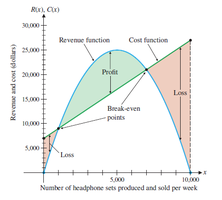
Interpretation:
Intersection points (break-even): and
Revenue exceeds cost for (profit region)
Cost exceeds revenue outside this interval (loss region)
Profit Function and Marginal Profit
Profit function:
Domain:
Marginal profit:
Interpretation at various production levels:
(profit increases with more production)
(profit does not change with more production)
(profit decreases with more production)
Marginal Average Cost, Revenue, and Profit
Definitions
Average Cost per Unit:
Marginal Average Cost: The derivative of the average cost function with respect to
Average Revenue per Unit:
Marginal Average Revenue: The derivative of the average revenue function with respect to
Average Profit per Unit:
Marginal Average Profit: The derivative of the average profit function with respect to
Example: Average and Marginal Average Cost
Given:
Average cost for 1,000 units:
Marginal average cost at 1,000 units: Each additional dictionary reduces the per unit cost by about
Estimated average cost for 1,001 units:
Caution: Order of Operations in Marginal Average Calculations
The marginal average cost function must be computed by first finding the average cost, then taking the derivative. Reversing the order yields a function with no useful interpretation. This caution also applies to marginal average revenue and profit functions.
Marginal cost: Interpreted as the instantaneous rate of change in the cost function and as an approximation of the exact cost of producing the (x+1)st item.
Marginal average cost: Only the first interpretation applies.
