 뒤로
뒤로The Point of Diminishing Returns in Business Calculus
스터디 가이드 - 스마트 노트
 자료에 맞춘 맞춤형 노트, 핵심 정의, 예시, 맥락을 확장해 제공합니다.
The Law of Diminishing Returns
Definition and Economic Context
The law of diminishing returns is a fundamental economic principle stating that as investment in a particular input increases, the resulting increase in output will eventually decline if all other inputs remain constant. This concept is crucial in production processes, such as farming and manufacturing, where inputs like labor, machinery, and raw materials are used to generate output.
Production Factors: Inputs such as labor, machine hours, and raw materials.
Optimal Output Level: The point at which increasing input further results in a lower rate of output increase.
Point of Diminishing Returns
Mathematical and Graphical Interpretation
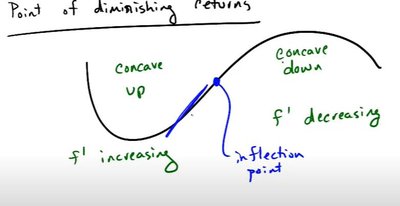
In calculus, the point of diminishing returns is identified as the value of the input variable where the rate of change of output (the derivative) transitions from increasing to decreasing. This is also known as the inflection point of the output function.
Inflection Point: The value of input where the second derivative changes sign, indicating a shift from concave up to concave down.
Concave Up: The output increases at an increasing rate (second derivative positive).
Concave Down: The output increases at a decreasing rate (second derivative negative).
Business Application Example
Suppose a company increases spending on advertising. Initially, sales increase at an increasing rate, but after a certain point, additional spending yields smaller increases in sales. The dollar amount at which the rate of change of sales shifts from increasing to decreasing is the point of diminishing returns.

Calculus Approach to Diminishing Returns
Finding the Point of Diminishing Returns
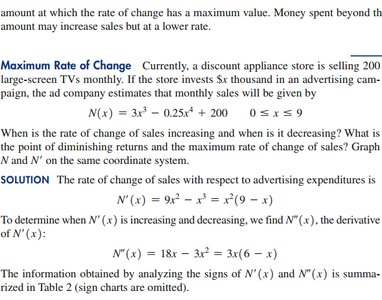
Given a function for output or sales, such as N(x), where x is the investment in advertising (in thousands of dollars), the point of diminishing returns can be found by:
Finding the first derivative, N'(x), which represents the rate of change of sales with respect to advertising.
Finding the second derivative, N''(x), to determine where the rate of change transitions from increasing to decreasing.
Solving N''(x) = 0 to find the inflection point.
Example Function:
Suppose monthly sales are modeled by:
where and is in thousands of dollars.
First derivative:
Second derivative:
Setting gives and (only positive values are relevant in this context).
Interpreting Results
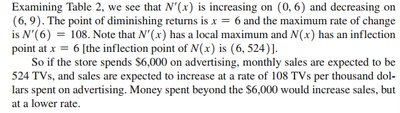
From the example, if the store spends $6,000 on advertising, the monthly sales are expected to be 524 TVs, and the rate of increase is 108 TVs per additional thousand dollars spent. Spending beyond this amount will still increase sales, but at a lower rate.
Graphical Representation
Visualizing the Point of Diminishing Returns
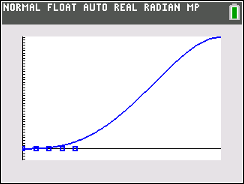
The graph of the output function typically shows an S-shape, with the inflection point marking the transition from increasing to decreasing marginal returns. This point is crucial for business decision-making, as it indicates the most efficient use of resources before returns start to diminish.
Summary Table: Key Calculus Concepts for Diminishing Returns
Concept | Mathematical Expression | Interpretation |
|---|---|---|
Output Function | Total output or sales as a function of input | |
Marginal Output | Rate of change of output with respect to input | |
Point of Diminishing Returns | Inflection point; rate of change shifts from increasing to decreasing |
Key Takeaways
The point of diminishing returns is where additional input yields smaller increases in output.
In calculus, this is the inflection point of the output function, found by setting the second derivative to zero.
Understanding this concept helps businesses optimize resource allocation for maximum efficiency.
