 뒤로
뒤로Arc Length, Surface Area of Revolution, and Fluid Force Problems – Step-by-Step Calculus Guidance
스터디 가이드 - 스마트 노트
 자료에 맞춘 맞춤형 노트, 핵심 정의, 예시, 맥락을 확장해 제공합니다.
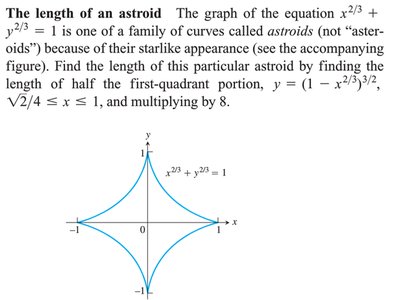
Q1. Find the length of the astroid defined by by calculating the length of half the first-quadrant portion, , for , and multiplying by 8.
Background
Topic: Arc Length of a Curve
This question tests your ability to use the arc length formula for a function , especially for curves defined implicitly or parametrically. The astroid is a classic example where symmetry can be used to simplify the calculation.
Key Terms and Formulas
Arc Length Formula: For , :
Astroid: A curve defined by .
Symmetry: The astroid is symmetric about both axes, so you can compute a portion and multiply by the appropriate factor.
Step-by-Step Guidance
Express as a function of in the first quadrant: for .
Find by differentiating with respect to . Use the chain rule carefully.
Write the arc length integral for the specified interval: .
Since the astroid is symmetric, multiply the result of this integral by 8 to get the total length.
Set up the integral, but do not evaluate it yet. Make sure your integrand is fully simplified and ready for calculation.
Try solving on your own before revealing the answer!
Final Answer:
The total length of the astroid is where .
After differentiating and simplifying, the integral becomes:
Evaluating this integral gives the total arc length of the astroid, which is $6$ (the exact value for this classic astroid).
This result uses the symmetry of the astroid and the arc length formula for a function of .
Q2. Find the lateral surface area of the cone generated by revolving the line segment , , about the y-axis. Check your answer with the geometry formula.
Background
Topic: Surface Area of Revolution
This question tests your ability to use the surface area formula for a curve revolved about an axis, and to compare calculus results with geometric formulas for known solids (cones).
Key Terms and Formulas
Surface Area of Revolution (about y-axis):
Geometry formula for cone lateral area: , where is the base radius and is the slant height.
Step-by-Step Guidance
Identify the curve and the interval: , .
Compute for the line segment.
Set up the surface area integral for revolution about the y-axis using the formula above.
Evaluate the integral setup, but do not compute the final value yet. Compare the setup to the geometry formula for a cone.
Try solving on your own before revealing the answer!
Final Answer:
The lateral surface area is .
Evaluating gives .
This matches the geometry formula for the lateral area of a cone with base radius and slant height .
Q3. A vertical right circular cylindrical tank measures 30 feet high and 20 feet in diameter. It is full of kerosene weighing 51.2 pounds per cubic foot. How much work does it take to pump the kerosene to the level of the tank?
Background
Topic: Work Done by Pumping Fluids
This question tests your understanding of work as an integral, especially in the context of lifting fluids against gravity. You need to set up an integral that accounts for the weight and distance each layer of fluid is lifted.
Key Terms and Formulas
Work: , where is the force at position .
Work to lift a thin slab:
Volume of a thin slab:
Weight of a thin slab:
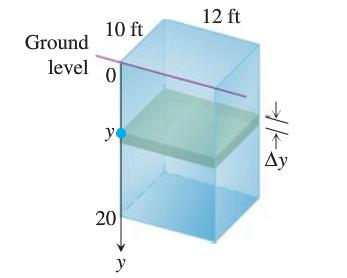
Step-by-Step Guidance
Let be the height above the tank bottom. The distance to lift a slab at height $y$ to the top is feet.
Write the volume of a thin horizontal slab at height as .
Write the weight of the slab as .
Set up the integral for total work: .
Simplify the integrand, but do not evaluate the integral yet.
Try solving on your own before revealing the answer!
Final Answer:
The work required is .
Evaluating gives .
The total work is ft-lb.
