 뒤로
뒤로Calculus I (MATH 2600) Syllabus and Course Structure – Study Guide
스터디 가이드 - 스마트 노트
 자료에 맞춘 맞춤형 노트, 핵심 정의, 예시, 맥락을 확장해 제공합니다.
Course Overview
Introduction to Calculus I (MATH 2600)
This course provides a comprehensive introduction to the foundational concepts of calculus, focusing primarily on differential calculus and its applications. Students will explore limits, continuity, derivatives, and the basics of integration, with an emphasis on problem-solving and real-world applications. The course is designed to build mathematical reasoning and analytical skills essential for further study in mathematics, science, and engineering.
Course Content and Structure
Main Topics Covered
Functions and Precalculus Review
Limits and Continuity
Differentiation and Its Applications
Introduction to Integration
Detailed Weekly Schedule
The course is organized into weekly modules, each focusing on specific sections and topics. Below is a summary of the tentative schedule and main content areas:
Week | Sections | Topics |
|---|---|---|
1 | 1.1-1.4 | Course Orientation; Algebra/Precalculus Review |
2 | 2.1-2.3 | The Idea of Limits; Limit of a Function; Techniques for Computing Limits |
3 | 2.4-2.7 | Infinite Limits; Limits at Infinity; Continuity; Precise Definition of a Limit |
4 | 3.1-3.5 | Introducing Derivatives; The Derivative as a Function; Rules of Differentiation; Product and Quotient Rule; Derivatives of Trigonometric Functions |
5 | 3.7 | The Chain Rule |
6-7 | 3.8-3.11 | Implicit Differentiation; Derivatives of Logarithmic and Exponential Functions; Related Rates |
7-8 | 4.1-4.6 | Maxima and Minima; Mean Value Theorem; What Derivatives Tell Us; Graphing Functions; Optimization |
9 | 4.7-5.1 | L’Hôpital’s Rule; Newton’s Method; Antiderivatives; Approximating Area under Curves |
10-11 | 5.2-5.5 | Definite Integrals; Fundamental Theorem of Calculus; Working with Integrals; Substitution Rule |
11-12 | 6.1-6.2 | Velocity and Net Change; Regions Between Curves |
Key Concepts and Definitions
Limits and Continuity
Limit of a Function: The value that a function approaches as the input approaches a certain point. Notation: $\lim_{x \to a} f(x) = L$
Continuity: A function is continuous at a point if the limit exists at that point and equals the function’s value there.
Infinite Limits and Limits at Infinity: Describes the behavior of functions as inputs grow very large or approach points where the function increases or decreases without bound.
Derivatives and Differentiation
Definition of the Derivative: The derivative of a function at a point measures the instantaneous rate of change of the function with respect to its variable. Notation: $f'(x) = \lim_{h \to 0} \frac{f(x+h) - f(x)}{h}$
Rules of Differentiation: Includes the power rule, product rule, quotient rule, and chain rule for finding derivatives of various types of functions.
Applications: Derivatives are used to find slopes of tangent lines, rates of change, and to solve optimization and related rates problems.
Applications of the Derivative
Maxima and Minima: Points where a function reaches its highest or lowest value locally or globally.
Mean Value Theorem: Guarantees that for a continuous and differentiable function, there is at least one point where the instantaneous rate of change equals the average rate of change.
Optimization: Using derivatives to find the best (maximum or minimum) values of functions in real-world contexts.
Integration and the Fundamental Theorem of Calculus
Antiderivative: A function whose derivative is the given function. Notation: $F(x)$ is an antiderivative of $f(x)$ if $F'(x) = f(x)$.
Definite Integral: Represents the signed area under a curve between two points. Notation: $\int_a^b f(x)\,dx$
Fundamental Theorem of Calculus: Connects differentiation and integration, stating that integration can be reversed by differentiation and vice versa.
Assessment and Grading
Evaluation Components
Homework and Reviews: 35% (must score above 70% on each assignment)
Chapter Quizzes: 25% (must score 55% or above on each quiz)
Midterm Exam: 20% (covers Chapters 1, 2, and 3.1-3.7; must score 55% or above)
Final Exam: 20% (cumulative; must score 55% or above)
Grading Scale
Letter Grade | Grade Scale | GPA Equivalency | Description |
|---|---|---|---|
A | 93-100 | 4.0 | Distinguished achievement |
B | 83-86 | 3.0 | High level of achievement |
C | 73-76 | 2.0 | Basic understanding |
D | 63-66 | 1.0 | Minimal performance |
F | 0-59 | 0.0 | Failure |
Student Learning Outcomes
Demonstrate knowledge of fundamental concepts of differential calculus, including limits, continuity, and differentiability.
Identify and apply appropriate rules for differentiation and integration.
Solve applications using differential calculus, including related rates and optimization.
Demonstrate knowledge of the fundamental concepts behind definite and indefinite integration.
Solve applications using integral calculus, including computing areas.
Course Resources and Policies
Required Materials
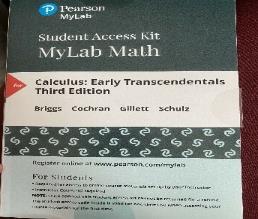
Access to MyLab Math (Pearson platform) for assignments and exams.
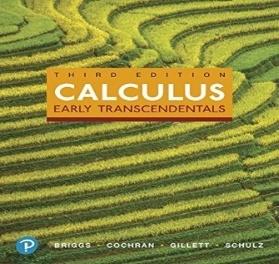
Textbook: Calculus: Early Transcendentals, 3rd Edition by Briggs, Cochran, Gillett, and Schulz.
Recommended Calculator: TI-83, TI-83+, TI-84, or TI-84+ (symbolic calculators not allowed).
Academic Integrity
All students are expected to do their own work and avoid plagiarism and cheating.
Violations may result in a grade of “F” and further disciplinary action.
Attendance and Participation
Active participation is required; excessive absences may affect grades.
Students are responsible for all material covered in class, even if absent.
Support Services
On-campus and online tutoring available by appointment.
Use MyLab Math tools such as “View an Example,” “Help Me Solve This,” and “Ask My Instructor.”
Library and wellness resources are available for academic and personal support.
Course Policies and Procedures
Assignments must be completed on time; late work is only accepted with documented extenuating circumstances and prior notification.
Students must use their official college email for all communications.
Accommodations for disabilities are available through the Office of Disability Services.
Withdrawal from the course must be completed through the Registrar’s office by the published deadlines.
Summary Table: Course Structure and Assessment
Component | Weight | Minimum Score Required |
|---|---|---|
Homework & Reviews | 35% | 70% |
Chapter Quizzes | 25% | 55% |
Midterm Exam | 20% | 55% |
Final Exam | 20% | 55% |
Additional Info
Course content aligns with standard Calculus I topics, including functions, limits, derivatives, applications of derivatives, and introductory integration.
Students are expected to spend 2 hours outside of class for every hour in class on coursework.
Course policies, support resources, and academic integrity guidelines are strictly enforced to ensure a fair and productive learning environment.
