 뒤로
뒤로Calculus I Syllabus and Course Structure – MATH 2600 (CT State Community College)
스터디 가이드 - 스마트 노트
 자료에 맞춘 맞춤형 노트, 핵심 정의, 예시, 맥락을 확장해 제공합니다.
Course Overview
Introduction to Calculus I
Calculus I (MATH 2600) is a foundational college course focusing on differential calculus and introductory integration. The course covers essential topics such as functions, limits, derivatives, applications of derivatives, and basic integration techniques. Students will learn to analyze and interpret mathematical relationships, solve real-life problems, and utilize technology to support their understanding.

Course Description and Learning Outcomes
Core Topics and Objectives
The course is structured around the following main topics, each corresponding to standard Calculus I chapters:
Functions: Understanding and analyzing mathematical functions.
Limits: Studying the behavior of functions as inputs approach specific values.
Derivatives: Learning the definition, computation, and interpretation of derivatives.
Applications of the Derivative: Solving problems involving rates of change, optimization, and graphing.
Integration: Introduction to antiderivatives and basic integration techniques.
Upon successful completion, students will:
Demonstrate knowledge of fundamental concepts of differential calculus, including limits, continuity, and differentiability.
Identify and apply appropriate rules for differentiation and integration.
Solve applications using differential calculus, including related rates and optimization.
Demonstrate knowledge of definite and indefinite integration concepts.
Solve applications using integral calculus, such as computing areas.
Course Materials
Required and Recommended Resources
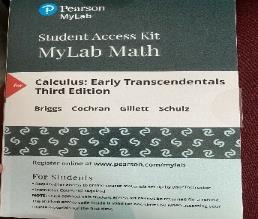
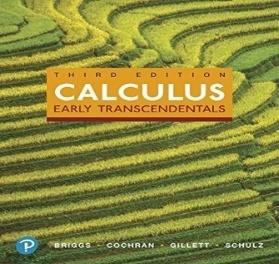
Textbook: Calculus: Early Transcendentals, Third Edition (Briggs, Cochran, Gillett, Schulz)
MyLab Math Access Code: Required for online assignments and assessments.
Graphing Calculator: TI-83, TI-83+, TI-84, TI-84+ recommended. Calculators with symbolic capability (e.g., TI-89, TI-92) are not allowed on quizzes/exams.
Supplementary notes and practice problems may be posted on Blackboard Learn.
Course Structure and Schedule
Weekly Topics and Assessments
The course follows a structured schedule, covering the following chapters and sections:
Week 1: Course orientation, algebra/precalculus review (Ch. 1)
Week 2: The idea of limits, definitions, techniques for computing limits (Ch. 2)
Week 3: Infinite limits, limits at infinity, continuity, precise definition of a limit (Ch. 2)
Week 4: Introducing derivatives, derivative as a function, rules of differentiation (Ch. 3)
Week 5: Chain rule, implicit differentiation, derivatives of logarithmic and exponential functions, related rates (Ch. 3)
Week 6-8: Maxima and minima, Mean Value Theorem, graphing functions, optimization, L'Hôpital's Rule, Newton's Method (Ch. 4)
Week 9-12: Antiderivatives, area under curves, definite integrals, Fundamental Theorem of Calculus, substitution rule, velocity and net change, regions between curves (Ch. 5-6)
Assessments include section homework, chapter quizzes, midterm exam, and cumulative final exam. All assignments are completed online via MyLab Math.
Evaluation & Grading
Grading Breakdown
Section Homework + Reviews: 35%
Chapter Quizzes (CH1-CH5): 25%
Midterm Exam: 20%
Final Exam: 20%
Minimum scores required: Homework/Reviews (70%), Quizzes/Exams (55%).
Grading Standards Table
Letter Grade | Grade Scale | GPA Equivalency | Description |
|---|---|---|---|
A | 93-100 | 4.0 | Distinguished achievement |
A- | 90-92 | 3.7 | |
B+ | 87-89 | 3.3 | |
B | 83-86 | 3.0 | High level of achievement |
B- | 80-82 | 2.7 | |
C+ | 77-79 | 2.3 | |
C | 73-76 | 2.0 | Basic understanding |
C- | 70-72 | 1.7 | |
D+ | 67-69 | 1.3 | |
D | 63-66 | 1.0 | Minimal performance |
D- | 60-62 | 0.7 | |
F | 0-59 | 0.0 | Failure |
Course Policies and Expectations
Assignment Completion and Academic Integrity
All assignments must be completed on time via MyLab Math.
Late assignments are not accepted except for documented emergencies.
Academic misconduct, including plagiarism and cheating, is strictly prohibited and may result in disciplinary action.
Attendance and Engagement
Active participation is required; excessive absence may affect grades.
Students are responsible for all class content, even if absent.
Student Support and Resources
Available Academic and Personal Support
MyLab Math tools: View an Example, Help Me Solve This, Get More Help.
On-campus and online tutoring available by appointment.
Library resources, mental health counseling, and disability accommodations are accessible to all students.
Course Communication and Technology
Digital Platforms and Instructor Contact
Primary communication via college email.
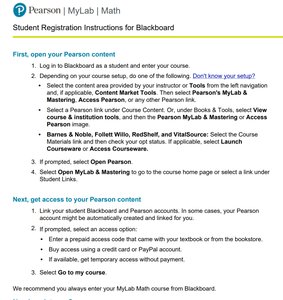
Course materials and announcements posted on Blackboard Learn.
MyLab Math is used for assignments, quizzes, and exams.
Accessibility and College Policies
Inclusivity, Accommodations, and Compliance
CT State Community College is committed to nondiscrimination and equal opportunity.
Students with disabilities should contact the Office of Disability Services for accommodations.
FERPA protects student privacy; class sessions may be recorded for educational purposes.
Title IX ensures a safe learning environment free from harassment and discrimination.
Course Design and Study Recommendations
Backward Design and Study Strategies
The course employs Universal Design for Learning (UDL) strategies, including lectures, videos, e-texts, and interactive exercises. Students are encouraged to engage in critical thinking, cooperative learning, and regular practice. Recommended study times per section:
Reading: 1–2 hours
Practice exercises: 2–4 hours
Homework: 1–2 hours
Quizzes: 2–3.5 hours
Exams: 2.5–3.5 hours



Summary Table: Calculus I Chapter Coverage
Chapter | Main Topics |
|---|---|
Ch. 1 | Functions, Precalculus Review |
Ch. 2 | Limits, Continuity |
Ch. 3 | Derivatives, Rules of Differentiation, Chain Rule, Implicit Differentiation |
Ch. 4 | Applications of Derivatives: Maxima/Minima, Mean Value Theorem, Optimization |
Ch. 5 | Integration: Antiderivatives, Definite Integrals, Fundamental Theorem of Calculus |
Ch. 6 | Applications of Integration: Velocity, Net Change, Regions Between Curves |
Additional Info
Additional info: The syllabus provides a comprehensive overview of course structure, policies, and resources, but does not include detailed mathematical content or worked examples. For exam preparation, students should refer to the textbook and MyLab Math assignments for practice problems and in-depth explanations.
