 뒤로
뒤로Calculus Study Guide: Critical Points, Graphing, Optimization, Linear Approximation, Limits, and Integration
스터디 가이드 - 스마트 노트
 자료에 맞춘 맞춤형 노트, 핵심 정의, 예시, 맥락을 확장해 제공합니다.
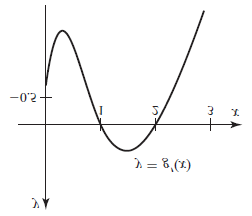
Q1. The following graph of the derivative has exactly two roots.
(a) Find the critical points of .
(b) For what values of in is increasing? Decreasing?
(c) For what values of in does have a local maximum? A local minimum?
Background
Topic: Critical Points, Increasing/Decreasing Intervals, Local Extrema
This question tests your understanding of how the graph of a derivative relates to the behavior of the original function, including finding critical points, intervals of increase/decrease, and local extrema.
Key Terms and Formulas:
Critical Points: Values of where or is undefined.
Increasing/Decreasing: is increasing where and decreasing where .
Local Maximum/Minimum: Use the First Derivative Test: a local maximum occurs where changes from positive to negative, and a local minimum occurs where changes from negative to positive.
Step-by-Step Guidance
Identify the -values where (the roots of the graph). These are the critical points of .
Determine the sign of on the intervals between the roots to find where is increasing or decreasing.
Check the behavior of around each critical point to determine if it is a local maximum or minimum (look for sign changes in ).
Summarize your findings for each part, but do not compute the final values yet.
Try solving on your own before revealing the answer!
Q2. Sketch a graph of a function that is continuous on and has the following properties. Use a sign graph to summarize information about the function.
(a) is undefined
(b) on
(c) on
Background
Topic: Sketching Functions from Derivative Information
This question tests your ability to interpret derivative information to sketch a possible graph of a function and summarize its behavior using a sign chart.
Key Terms and Formulas:
Critical Point (where derivative is undefined): May indicate a cusp or corner.
Increasing/Decreasing: is increasing where and decreasing where .
Sign Graph: A chart showing the sign of on intervals.
Step-by-Step Guidance
Mark as a special point where is undefined.
On , , so is increasing there.
On , , so is decreasing there.
Sketch a function that increases up to and then decreases after , with a sharp point or cusp at $x = -1$.
Try solving on your own before revealing the answer!
Q3. Find the intervals on which is increasing and the intervals on which it is decreasing.
(a)
(b)
(c) ,
Background
Topic: Increasing/Decreasing Intervals Using the First Derivative
This question tests your ability to find where a function is increasing or decreasing by analyzing the sign of its first derivative.
Key Terms and Formulas:
First Derivative: tells you where is increasing () or decreasing ().
Critical Points: Where or is undefined.
Step-by-Step Guidance
Compute for each function.
Solve to find critical points.
Test intervals between critical points to determine the sign of .
State the intervals where is increasing or decreasing, but do not list the final intervals yet.
Try solving on your own before revealing the answer!
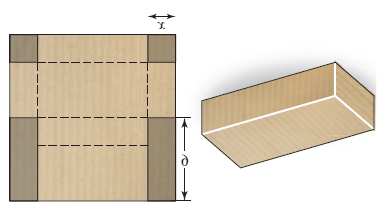
Q9. Two squares of length are cut out of adjacent corners of an piece of cardboard and two rectangles of length and width are cut out of the other two corners of the cardboard (see figure). The resulting piece of cardboard is then folded along the dashed lines to form an enclosed box. Find the dimensions and volume of the largest box that can be formed in this way.
Background
Topic: Optimization (Maximizing Volume)
This problem involves using calculus to maximize the volume of a box formed by cutting and folding a piece of cardboard, a classic optimization scenario.
Key Terms and Formulas:
Volume of a Box:
Optimization: Find the value of that maximizes , subject to the constraints of the problem.
Critical Points: Where or is undefined.
Step-by-Step Guidance
Express the dimensions of the box in terms of based on the cuts and folds described.
Write the volume as a function of using the expressions for length, width, and height.
Find the derivative and set it equal to zero to find critical points.
Check which critical point gives the maximum volume, but do not compute the final value yet.
Try solving on your own before revealing the answer!
