 뒤로
뒤로Guided Practice: Evaluating Limits Using Graphs
스터디 가이드 - 스마트 노트
 자료에 맞춘 맞춤형 노트, 핵심 정의, 예시, 맥락을 확장해 제공합니다.
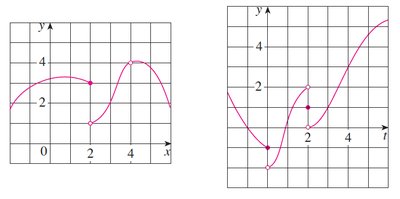
Q2. Use the graphs of f and g to evaluate the following limits:
\( \lim_{x \to 2^-} (f(x) - g(x)) \)
\( \lim_{x \to 2^+} (f(x) - g(x)) \)
\( \lim_{x \to 2} (f(x) - g(x)) \)
\( \lim_{x \to 2^+} \frac{f(x)}{g(x)} \)
\( f(2) + g(2) + \lim_{x \to -1} g(x) \)
\( \lim_{x \to 4} (x^2 g(x)) \)
\( f(0) + \lim_{x \to 4} f(x) \)
\( \lim_{x \to 4} 3(f(x) + g(t)) \)
Background
Topic: Limits and Graphical Analysis
These questions test your ability to evaluate limits using the graphs of two functions, \( f(x) \) and \( g(x) \). You will need to interpret the behavior of the functions as \( x \) approaches specific values from the left (\( ^- \)), right (\( ^+ \)), or both sides, and sometimes use the actual function values.
Key Terms and Concepts:
Limit from the left (\( x \to a^- \)): The value the function approaches as \( x \) approaches \( a \) from values less than \( a \).
Limit from the right (\( x \to a^+ \)): The value the function approaches as \( x \) approaches \( a \) from values greater than \( a \).
Function value (\( f(a) \)): The actual value of the function at \( x = a \), if defined.
Difference of functions: \( f(x) - g(x) \) means subtract the value of \( g(x) \) from \( f(x) \) at each point.
Quotient of functions: \( \frac{f(x)}{g(x)} \) means divide the value of \( f(x) \) by \( g(x) \) at each point (if \( g(x) \neq 0 \)).
Step-by-Step Guidance
For each limit, locate the relevant \( x \)-value on the graph (e.g., \( x = 2 \), \( x = -1 \), \( x = 4 \), etc.).
For one-sided limits (e.g., \( x \to 2^- \)), trace the graph as \( x \) approaches the value from the left or right. Observe the \( y \)-values that \( f(x) \) and \( g(x) \) approach.
For expressions like \( f(x) - g(x) \) or \( \frac{f(x)}{g(x)} \), evaluate the limit for each function separately, then combine as indicated (subtract or divide).
For limits involving function values (e.g., \( f(2) \)), check if the function is defined at that point (solid dot means defined, open dot means not defined).
For composite expressions (e.g., \( x^2 g(x) \)), multiply the value of \( x^2 \) by the value or limit of \( g(x) \) as \( x \) approaches the specified value.
Try solving on your own before revealing the answer!
