 뒤로
뒤로Implicit Differentiation and Applications
스터디 가이드 - 스마트 노트
 자료에 맞춘 맞춤형 노트, 핵심 정의, 예시, 맥락을 확장해 제공합니다.
Techniques of Differentiation
Implicit Differentiation
Implicit differentiation is a method used to find the derivative of functions that are not explicitly solved for one variable in terms of another. This technique is especially useful when dealing with equations where y is defined implicitly as a function of x, rather than explicitly.
Implicit Function: An equation involving both x and y that defines y as a function of x indirectly.
Key Idea: Differentiate both sides of the equation with respect to x, treating y as a function of x (i.e., apply the chain rule when differentiating terms involving y).
Example: Implicit Differentiation of a Circle
Consider the equation of a circle: . To find , differentiate both sides with respect to x:
Solving for gives:
This formula applies to any point on the circle, not just those below the x-axis. Note that the derivative involves both variables x and y.
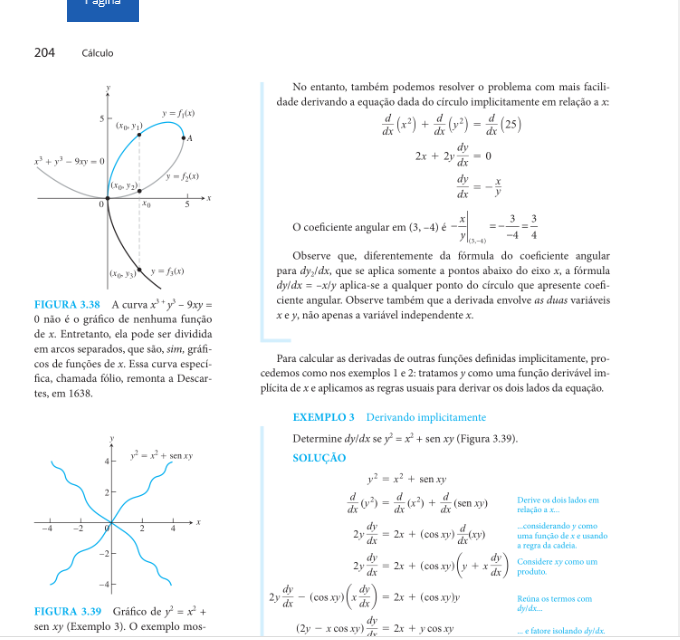
Example: Implicit Differentiation with Trigonometric Terms
Given , find .
Differentiating both sides with respect to x:
Apply the product rule to :
Substitute back:
Expand and collect terms involving :
Factor :
Finally, solve for :
Key Steps in Implicit Differentiation
Step 1: Differentiate both sides of the equation with respect to x.
Step 2: Apply the chain rule to terms involving y (i.e., ).
Step 3: Collect all terms involving on one side of the equation.
Step 4: Factor and solve for .
Applications and Observations
Implicit differentiation is essential for finding slopes of curves not given as explicit functions.
It is widely used in calculus for analyzing curves, especially those defined by equations involving both x and y.
Historical note: The folium of Descartes () is a classic example of a curve studied using implicit differentiation.
