뒤로
뒤로Infinite Sequences and Their Limits
스터디 가이드 - 스마트 노트
 자료에 맞춘 맞춤형 노트, 핵심 정의, 예시, 맥락을 확장해 제공합니다.
Infinite Sequences
Definition of a Sequence
A sequence is an ordered list of numbers, typically denoted as a1, a2, a3, .... Each number in the sequence is called a term, and the position of each term is indicated by a positive integer known as the index n. More precisely, a sequence is a function whose domain is the set of positive integers.
Notation: A sequence is usually written as {an} or an.
Range: The set of all values taken by the sequence.
Graphical Representation: Sequences can be shown as points on a graph, where the x-axis represents the index n and the y-axis represents the value an.
Example: The sequence an = 1/n is {1, 1/2, 1/3, 1/4, ...}.
Limits of Sequences
Definition of the Limit of a Sequence
A sequence {an} has a limit L (written as ) if for every , there exists an integer N such that for all , .
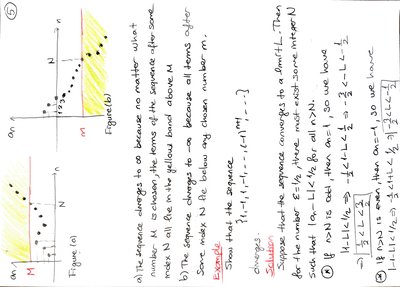
If such an L exists, the sequence is called convergent.
If no such L exists, the sequence is called divergent.
Example: Show that .
Given , choose N such that .
For all , .
Graphical Illustration of Convergence and Divergence
Convergent sequences eventually stay within any horizontal band around the limit, while divergent sequences do not.
Calculating Limits of Sequences
Limit Laws for Sequences
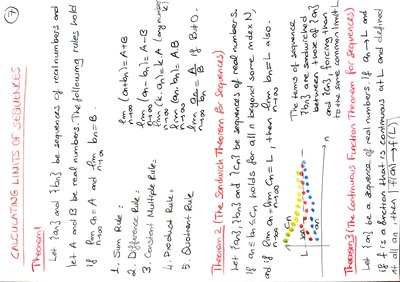
Let {an} and {bn} be sequences of real numbers, and let A and B be real numbers. If and , then:
Sum Rule:
Difference Rule:
Product Rule:
Quotient Rule: , provided
Theorems for Limits of Sequences
Theorem 2 (The Sandwich Theorem for Sequences): If for all n beyond some N, and , then .
Theorem 3 (The Continuous Function Theorem for Sequences): If is continuous at and , then .
Examples of Limits
(for any constant k)
Recursive Definitions
Definition and Examples
A sequence can be defined recursively by specifying one or more initial terms and a formula for calculating each term from the preceding terms.
Example: The sequence defined by , for gives $a_1 = 2$, , , etc.
Monotonic Sequences and Boundedness
Definitions
A sequence is increasing if for all n.
A sequence is decreasing if for all n.
A sequence is monotonic if it is either increasing or decreasing.
A sequence is bounded if there exists a number M such that for all n.
Example:
The sequence {1, 2, 3, ...} is increasing.
The sequence {1, 1/2, 1/3, ...} is decreasing.
The sequence {1, -1, 1, -1, ...} is not monotonic.
Theorem 6 (The Monotonic Sequence Theorem)
If a sequence is both bounded and monotonic, then it is convergent.
Additional info: The converse is not necessarily true; not all convergent sequences are monotonic.
Worked Examples and Applications
Applying the Monotonic Sequence Theorem
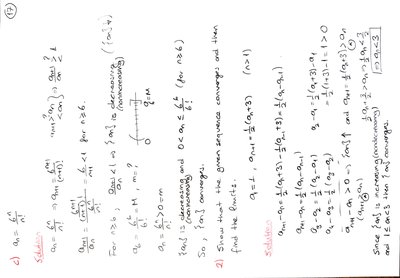
Given a sequence , show it is decreasing and bounded below by 0, so it converges to 0.
Given a recursively defined sequence, use induction or algebraic manipulation to show boundedness and monotonicity, then apply the theorem to conclude convergence.