 뒤로
뒤로Integration of Rational Functions by Partial Fractions and Volumes Using Cross-Sections
스터디 가이드 - 스마트 노트
 자료에 맞춘 맞춤형 노트, 핵심 정의, 예시, 맥락을 확장해 제공합니다.
Integration of Rational Functions by Partial Fractions
Introduction to Partial Fractions
Integration by partial fractions is a technique used to integrate rational functions, which are quotients of polynomials. This method decomposes a complex rational function into a sum of simpler fractions that are easier to integrate.
Rational Function: A function of the form , where and are polynomials.
Proper Rational Function: The degree of is less than the degree of .
Improper Rational Function: The degree of is greater than or equal to the degree of . In this case, perform polynomial long division first.
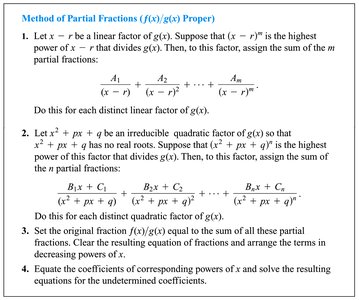
Method of Partial Fractions (Proper Case)
The decomposition depends on the factorization of the denominator :
For each distinct linear factor of , assign a sum of the form:
For each irreducible quadratic factor (where ), assign:
Set the original function equal to the sum of all partial fractions and arrange terms by decreasing powers of .
Equate coefficients of corresponding powers of and solve for the unknowns.
Example: Distinct Linear Factors
Given , factor the denominator and decompose:
Factor:
Decomposition:
Solve for by equating coefficients.
Example: Irreducible Quadratic Factors
Given , the decomposition includes terms like , , .
Summary Table: Partial Fraction Decomposition Forms
Denominator Factor | Partial Fraction Form |
|---|---|
Distinct Linear | |
Repeated Linear | |
Irreducible Quadratic | |
Repeated Irreducible Quadratic |
Volumes Using Cross-Sections
Introduction to Solids of Known Cross-Section
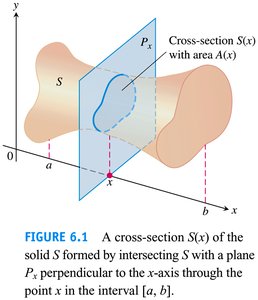
The volume of a solid can be found by integrating the area of cross-sections perpendicular to an axis. This method is foundational in applications of definite integrals.
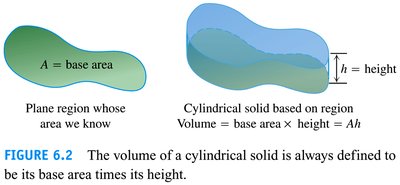
Volume of a Cylindrical Solid
For a solid with constant cross-sectional area and height , the volume is .
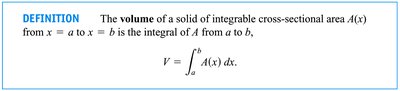
General Volume Formula
If the cross-sectional area varies with , the volume from to is:
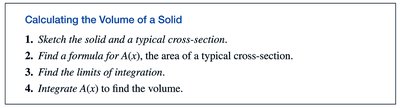
Steps for Calculating the Volume of a Solid
Sketch the solid and a typical cross-section.
Find a formula for , the area of a typical cross-section.
Find the limits of integration.
Integrate to find the volume.
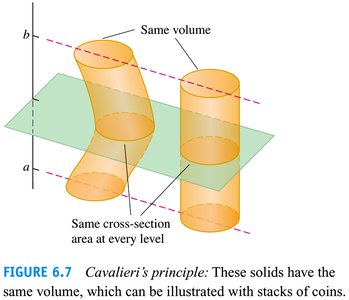
Cavalieri's Principle
If two solids have equal heights and equal cross-sectional areas at every level, then they have equal volumes.
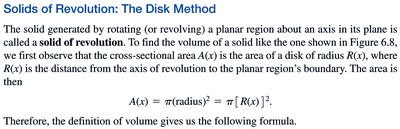
Solids of Revolution: The Disk Method
Volume by Disks for Rotation About the x-Axis
When a region is revolved about the x-axis, the resulting solid's volume can be found using the disk method:
Where is the distance from the axis of rotation to the outer edge of the region.

Example: Volume of a Sphere
The volume of a sphere of radius can be derived by integrating the area of circular cross-sections:
Cross-sectional area at :
Volume:
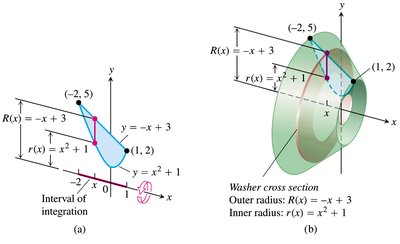
Solids of Revolution: The Washer Method
Volume by Washers for Rotation About the x-Axis
If the solid has a hole (i.e., the region does not border the axis of revolution), use the washer method:
Outer radius:
Inner radius:
Area of washer:
Volume:
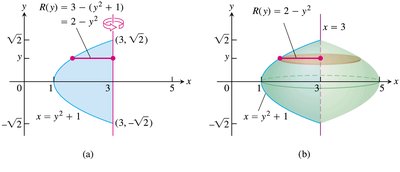
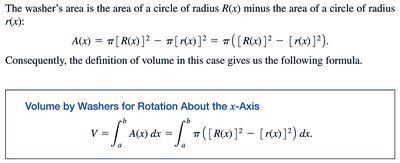
Example: Region Between Two Curves
To find the volume generated by rotating the region between and about the x-axis:
Outer radius:
Inner radius:
Volume:
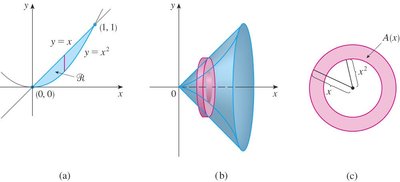
Example: Rotation About a Line Other Than the Axis
When rotating about , adjust the radii accordingly:
Outer radius:
Inner radius:
Volume:
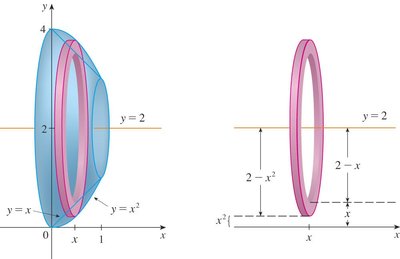
Summary Table: Methods for Finding Volumes of Solids of Revolution
Method | Formula | When to Use |
|---|---|---|
Disk | Solid has no hole; region borders axis of revolution | |
Washer | Solid has a hole; region does not border axis | |
Cross-Section | General solids with known cross-sectional area |
Additional info: The notes above include both the algebraic and geometric foundations for integrating rational functions by partial fractions and for calculating volumes of solids using cross-sections, disks, and washers. These are core topics in Calculus II and are essential for applications in physics, engineering, and advanced mathematics.
