 뒤로
뒤로Logarithmic and Exponential Functions with Other Bases
스터디 가이드 - 스마트 노트
 자료에 맞춘 맞춤형 노트, 핵심 정의, 예시, 맥락을 확장해 제공합니다.
Logarithmic and Exponential Functions with Other Bases
General Exponential Functions
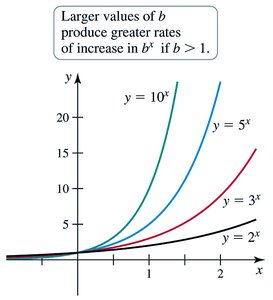
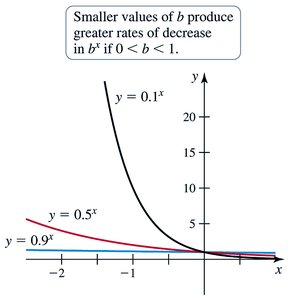
Exponential functions of the form f(x) = bx are fundamental in calculus, especially when the base b is not equal to the natural base e. The properties of these functions depend on the value of b:
Domain:
Range:
For all :
If : is an increasing function
If : is a decreasing function
Exponential functions can be rewritten using the natural exponential function:
This representation is useful for differentiation and integration.
General Logarithmic Functions
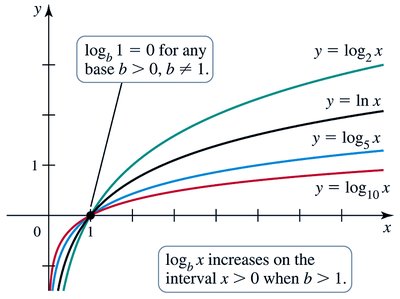
The logarithmic function with base b, denoted logbx, is the inverse of the exponential function bx. For any base , , the function is one-to-one and has the following properties:
Domain:
Range:
logb1 = 0 for any base ,
If : is an increasing function
Inverse Relations for Exponential and Logarithmic Functions
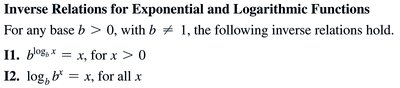
Exponential and logarithmic functions are inverses of each other. The following relations hold for any base , :
, for
, for all
Derivatives of Exponential Functions
The derivative of an exponential function with base is given by:
For a function ,
Example: Find the derivative of :
Integrals of Exponential Functions
The indefinite integral of an exponential function with base is:
Example:
The General Power Rule
The general power rule applies to functions of the form :
, for real and
If is a positive differentiable function,
Example:
Derivatives of General Logarithmic Functions
The derivative of the logarithmic function with base is:
, for
For ,
Summary of New Rules
Integral Rules | Derivative Rules |
|---|---|
Additional info:
Some images, such as image_6, depict trigonometric unit circle values and are not directly relevant to the topic of logarithmic and exponential functions, so they are not included.
