 뒤로
뒤로Vectors and Three-Dimensional Geometry: Study Notes for Calculus Students
스터디 가이드 - 스마트 노트
 자료에 맞춘 맞춤형 노트, 핵심 정의, 예시, 맥락을 확장해 제공합니다.
Vectors
Definition and Basic Properties
Vectors are fundamental objects in mathematics and physics, characterized by both magnitude and direction. They are distinct from scalars, which possess only magnitude. Vectors are typically represented as directed line segments, with an initial and terminal point. The magnitude (or length) of a vector is denoted by .
Scalars: Quantities with only magnitude (e.g., mass, time).
Vectors: Quantities with magnitude and direction (e.g., force, velocity).
Notation: Vectors can be denoted as , , or in component form .
Equality: Two vectors are equal if they have the same magnitude and direction, regardless of their initial points.
Multiplication by a Scalar
Multiplying a vector by a scalar scales its magnitude by and reverses its direction if .
If is a vector, then is a vector in the same direction if , opposite if , and the zero vector if .
Vector Addition and Subtraction
Vectors can be added geometrically using the triangle law (head-to-tail) or the parallelogram law (tail-to-tail). Subtraction is defined as addition of the negative vector.
Triangle Law: is the vector from the start of to the end of when placed head-to-tail.
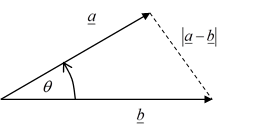
Parallelogram Law: is the diagonal of the parallelogram formed by and .
Subtraction: .
Component Form of Vectors
Vectors in the plane are often written in component form as . For points and , .
Operations in Component Form
Addition:
Scalar Multiplication:
Magnitude:
Unit Vectors and Linear Combinations
A unit vector has magnitude 1. The standard unit vectors in are and . Any vector can be written as .
The Dot Product
Definition and Properties
The dot product (or scalar product) of two vectors and is:
The result is a scalar, not a vector.
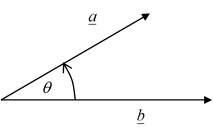
Geometric Interpretation: , where is the angle between and .
Orthogonality: Vectors are perpendicular if and only if their dot product is zero.
Projections
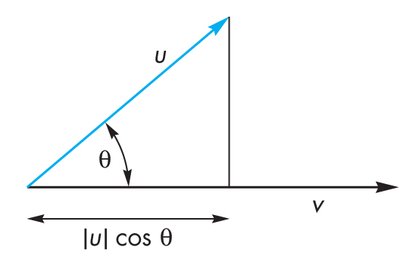
The projection of onto is a vector in the direction of whose magnitude is the component of along $\vec{v}$.
Scalar projection:
Vector projection:
Three-Dimensional Vectors and Geometry
Coordinates and Planes in
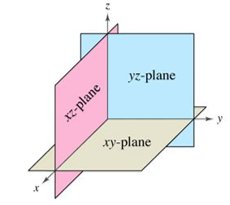
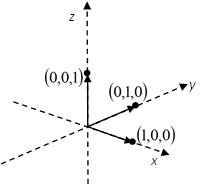
Points in space are represented as ordered triples . The three coordinate axes (, , ) are mutually perpendicular and define the -, -, and -planes.
Distance in
The distance between points and is:
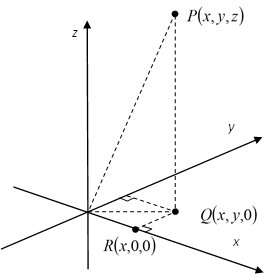
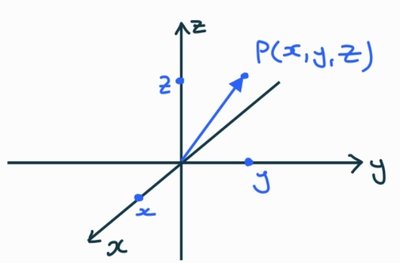
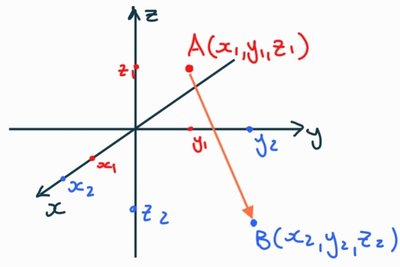
Standard Unit Vectors in
The standard unit vectors are:
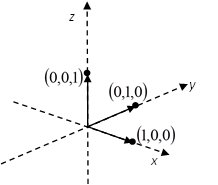
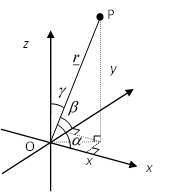
Direction Cosines
For a vector , the direction cosines are , , , where are the angles with the -, -, and -axes, respectively.
Vector Equations of Lines and Planes
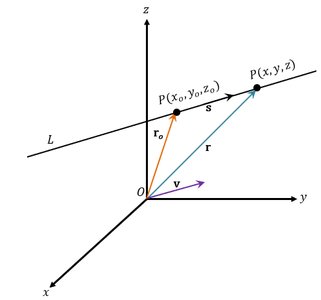
Line in
The vector equation of a line through point and parallel to vector is:
,
Plane in
A plane with normal vector passing through point has the equation:
Intersections
Lines: Two lines may intersect at a point, be parallel, or be skew (not intersecting and not parallel).
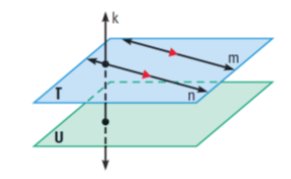
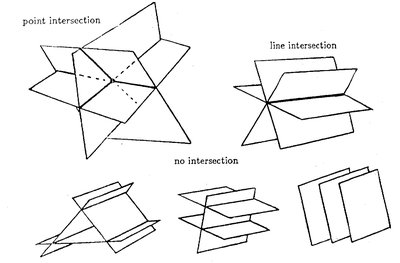
Planes: Two planes may be parallel, coincide, or intersect in a line. Three planes may intersect at a point, along a line, or not at all.
Cross Product and Scalar Triple Product
Cross Product
The cross product of and is:
The result is a vector perpendicular to both and .
Magnitude:
Scalar Triple Product
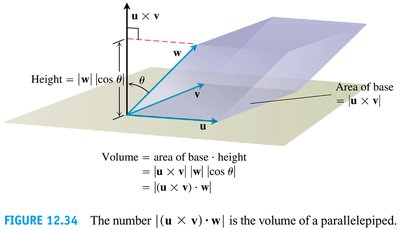
The scalar triple product gives the volume of the parallelepiped defined by , , and :
Complex Numbers: Roots and Geometry
Roots of Complex Numbers
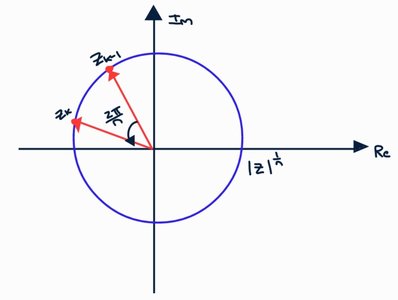
The th roots of a complex number are given by:
,
The roots are equally spaced around a circle in the complex plane.
Additional info: These notes cover the foundational aspects of vectors, vector operations, and three-dimensional geometry, as well as the geometric interpretation of complex roots. They are suitable for students preparing for Calculus exams, especially those focusing on vector-valued functions and spatial reasoning.
