Ch. 1 - Functions
Briggs - Calculus: Early Transcendentals 3rd Edition
Briggs3rd EditionCalculus: Early TranscendentalsISBN: 9780136847243당신이 사용하는 게 아니라요?교과서 변경
1장, 문제 19d

Composite functions
Let ƒ(x) = x³, g (x) = sin x and h(x) = √x.
Find the domain of g o ƒ.

검증된 단계별 안내
1
The composition of functions \( g \circ f \) means applying function \( g \) to the result of function \( f \). In this case, \( g \circ f(x) = g(f(x)) = g(x^3) = \sin(x^3).\)
The function \( f(x) = x^3 \) is a polynomial, and polynomials are defined for all real numbers. Therefore, the domain of \( f(x) \) is all real numbers, \( (-\infty, \infty) \).
The sine function, \( \sin x \), is defined for all real numbers. Therefore, the domain of \( g(x) \) is also all real numbers, \( (-\infty, \infty) \).
Since \( f(x) = x^3 \) is defined for all real numbers and \( g(x) = \sin x \) is also defined for all real numbers, the composition \( g \circ f(x) = \sin(x^3) \) is defined for all real numbers.
The domain of \( g \circ f \) is the set of all real numbers, \( (-\infty, \infty) \), because both \( f(x) \) and \( g(x) \) are defined for all real numbers.

비슷한 문제에 대한 검증된 영상 답변:

이 영상 해법은 위 문제에 도움이 된다고 튜터들이 추천한 것입니다.
영상 길이:
2m

주요 개념

질문에 올바르게 답하기 위해 반드시 이해해야 하는 핵심 개념들은 다음과 같습니다.

Composite Functions

A composite function is formed when one function is applied to the result of another function. In this case, g o ƒ means we first apply the function ƒ to x, and then apply g to the result of ƒ(x). Understanding how to combine functions is essential for determining the overall behavior and properties of the composite function.
추천 영상:
3:48
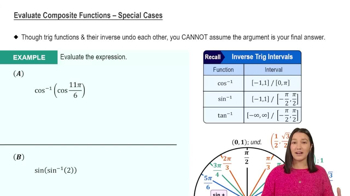
Evaluate Composite Functions - Special Cases

Domain of a Function

The domain of a function is the set of all possible input values (x-values) for which the function is defined. For composite functions, the domain is influenced by both the inner function and the outer function. To find the domain of g o ƒ, we must ensure that the output of ƒ(x) falls within the domain of g(x).
추천 영상:
가이드 코스
5:10
Finding the Domain and Range of a Graph

Function Behavior and Restrictions

Different functions have specific restrictions that affect their domains. For example, the function g(x) = sin x is defined for all real numbers, while ƒ(x) = x³ is also defined for all real numbers. However, if we were to consider a function like h(x) = √x, it would impose restrictions since it is only defined for x ≥ 0. Understanding these behaviors is crucial for determining the valid inputs for composite functions.
추천 영상:
가이드 코스
7:24
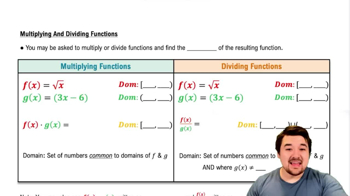
Multiplying & Dividing Functions