Ch. 1 - Functions
Briggs - Calculus: Early Transcendentals 3rd Edition
Briggs3rd EditionCalculus: Early TranscendentalsISBN: 9780136847243당신이 사용하는 게 아니라요?교과서 변경
1장, 문제 19e

Composite functions
Let ƒ(x) = x³, g (x) = sin x and h(x) = √x.
Find the domain of ƒ o g.

검증된 단계별 안내
1
insert step 1> Identify the functions involved in the composition. Here, we have \( f(x) = x^3 \) and \( g(x) = \sin x \).
insert step 2> Understand the composition \( (f \circ g)(x) = f(g(x)) \). This means we first apply \( g(x) \) and then apply \( f \) to the result.
insert step 3> Determine the domain of \( g(x) = \sin x \). The sine function is defined for all real numbers, so the domain of \( g \) is \( (-\infty, \infty) \).
insert step 4> Consider the domain of \( f(x) = x^3 \). The cube function is also defined for all real numbers, so the domain of \( f \) is \( (-\infty, \infty) \).
insert step 5> Since both \( g(x) \) and \( f(x) \) are defined for all real numbers, the domain of \( f \circ g \) is the same as the domain of \( g(x) \), which is \( (-\infty, \infty) \).

주요 개념

질문에 올바르게 답하기 위해 반드시 이해해야 하는 핵심 개념들은 다음과 같습니다.

Composite Functions

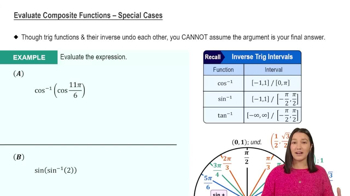
A composite function is formed when one function is applied to the result of another function. In mathematical notation, if f(x) and g(x) are two functions, the composite function f(g(x)) is evaluated by first calculating g(x) and then applying f to that result. Understanding how to combine functions is essential for solving problems involving their domains and ranges.
추천 영상:
3:48
Evaluate Composite Functions - Special Cases

Domain of a Function

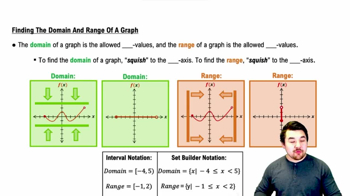
The domain of a function is the set of all possible input values (x-values) for which the function is defined. For composite functions, the domain is determined by the inner function and any restrictions imposed by the outer function. Identifying the domain is crucial for ensuring that all operations within the functions are valid and do not lead to undefined expressions.
추천 영상:
가이드 코스
5:10
Finding the Domain and Range of a Graph

Restrictions on Functions

Restrictions on functions arise from operations that can limit the input values. For example, the square root function h(x) = √x is only defined for x ≥ 0, while the sine function g(x) = sin x is defined for all real numbers. When finding the domain of composite functions, it is important to consider these restrictions to ensure that the resulting function is valid across its entire domain.
추천 영상:
가이드 코스
7:24
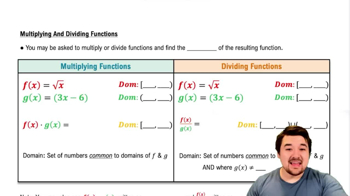
Multiplying & Dividing Functions