Ch. 1 - Functions
Briggs - Calculus: Early Transcendentals 3rd Edition
Briggs3rd EditionCalculus: Early TranscendentalsISBN: 9780136847243당신이 사용하는 게 아니라요?교과서 변경
1장, 문제 108

Design a sine function with the given properties.
It has a period of 1212 with a minimum value of 4-4 at t=0t=0 and a maximum value of 44 at t=6t=6.

검증된 단계별 안내
1
Identify the general form of a sine function: y = A * sin(B(t - C)) + D, where A is the amplitude, B affects the period, C is the phase shift, and D is the vertical shift.
Determine the amplitude (A) by calculating the difference between the maximum and minimum values, then divide by 2. Here, A = (4 - (-4)) / 2 = 4.
Calculate the vertical shift (D) by finding the average of the maximum and minimum values. Here, D = (4 + (-4)) / 2 = 0.
Use the given period to find B. The period of a sine function is given by (2π / B). Set this equal to 12 and solve for B: 2π / B = 12, so B = 2π / 12 = π / 6.
Determine the phase shift (C) using the information that the minimum value occurs at t = 0. Since the sine function normally has a minimum at -π/2, set B(t - C) = -π/2 when t = 0, and solve for C. This gives C = π/3.

비슷한 문제에 대한 검증된 영상 답변:

이 영상 해법은 위 문제에 도움이 된다고 튜터들이 추천한 것입니다.
영상 길이:
10m
도움이 되었나요?

주요 개념

질문에 올바르게 답하기 위해 반드시 이해해야 하는 핵심 개념들은 다음과 같습니다.

Sine Function Properties

The sine function is a periodic function characterized by its amplitude, period, and phase shift. The amplitude determines the height of the wave, while the period defines the length of one complete cycle. Understanding these properties is essential for designing a sine function that meets specific criteria, such as maximum and minimum values.
추천 영상:
06:21
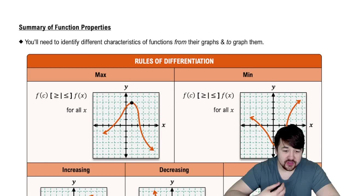
Properties of Functions

Period of a Function

The period of a function is the distance along the x-axis over which the function completes one full cycle. For the sine function, the standard period is 2π, but it can be adjusted by a scaling factor. In this case, a period of 12 means the function will repeat every 12 units along the t-axis, which is crucial for setting the function's behavior.
추천 영상:
6:22
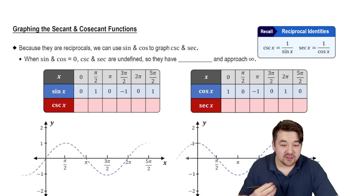
Graphs of Secant and Cosecant Functions

Vertical Shift

A vertical shift in a sine function alters its midline, effectively moving the entire graph up or down. This is important for achieving specific maximum and minimum values. For instance, to have a minimum of -4 and a maximum of 4, the sine function must be vertically shifted down by 4 units, adjusting its range accordingly.
추천 영상:
5:30
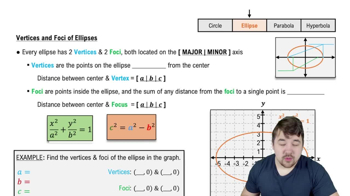
Foci and Vertices of an Ellipse
관련 실천
교과서 질문

Daylight function for 40 °N Verify that the function D(t)=2.8sin(2π365(t81))+12D(t)=2.8\(\sin\)(\(\frac{2\pi}{365}\)(t-81))+12 has the following properties, where t is measured in days and D is the number of hours between sunrise and sunset.


D(81)=12D(81) = 12 and D(264)12D(264) ≈ 12  (corresponding to the equinoxes).

545
views

교과서 질문

Daylight function for 40 °N Verify that the function D(t)=2.8sin(2π365(t81))+12D(t)=2.8\(\sin\)(\(\frac{2\pi}{365}\)(t-81))+12 has the following properties, where t is measured in days and D is the number of hours between sunrise and sunset.


Its maximum and minimum values are 14.8 and 9.2, respectively, which occur approximately at t=172t= 172  and t=355t = 355, respectively (corresponding to the solstices).

527
views
교과서 질문

Area of a circular sector Prove that the area of a sector of a circle of radius r associated with a central angle θ\(\theta\) (measured in radians) is A=12r2θA=\(\frac\)12r^2\(\theta\).

<IMAGE>

460
views
교과서 질문

{Use of Tech} Triple intersection Graph the functions f(x) = x³,g(x)=3^x, and h(x)=x^x and find their common intersection point (exactly).

368
views
교과서 질문

Beginning with the graphs of y=sinxy=\(\sin\) x or y=cosxy=\(\cos\) x, use shifting and scaling transformations to sketch the graph of the following functions. Use a graphing utility to check your work.

q(x)=3.6cos(πx24)+2q\(\left\)(x\(\right\))=3.6\(\cos\[\left\)(\(\frac{\pi x}{24}\]\right\))+2

257
views
교과서 질문

Daylight function for 40 °N Verify that the function D(t)=2.8sin(2π365(t81))+12D(t)=2.8\(\sin\)(\(\frac{2\pi}{365}\)(t-81))+12 has the following properties, where t is measured in days and D is the number of hours between sunrise and sunset. It has a period of 365 days.

626
views