Ch. 1 - Functions
Briggs - Calculus: Early Transcendentals 3rd Edition
Briggs3rd EditionCalculus: Early TranscendentalsISBN: 9780136847243당신이 사용하는 게 아니라요?교과서 변경
1장, 문제 107

Beginning with the graphs of y=sinxy=\(\sin\) x or y=cosxy=\(\cos\) x, use shifting and scaling transformations to sketch the graph of the following functions. Use a graphing utility to check your work.
q(x)=3.6cos(πx24)+2q\(\left\)(x\(\right\))=3.6\(\cos\[\left\)(\(\frac{\pi x}{24}\]\right\))+2

검증된 단계별 안내
1
Start with the basic graph of y = \(\cos\)(x), which is a cosine wave with an amplitude of 1, a period of 2\(\pi\), and a midline at y = 0.
Apply a horizontal scaling transformation to the function. The term \(\frac{\pi x}{24}\) inside the cosine function indicates a horizontal stretch. The period of the cosine function is given by \(\frac{2\pi}{\frac{\pi}{24}\)} = 48. This means the graph completes one full cycle over an interval of 48 units on the x-axis.
Apply a vertical scaling transformation. The coefficient 3.6 in front of the cosine function indicates a vertical stretch. This changes the amplitude of the cosine wave from 1 to 3.6, meaning the wave will oscillate between -3.6 and 3.6.
Apply a vertical shift. The +2 at the end of the function indicates a vertical shift upwards by 2 units. This moves the midline of the cosine wave from y = 0 to y = 2, so the wave will now oscillate between -1.6 and 5.6.
Combine all transformations to sketch the graph of q(x) = 3.6\(\cos\[\left\)(\(\frac{\pi x}{24}\]\right\)) + 2. The graph is a cosine wave with a period of 48, an amplitude of 3.6, and a midline at y = 2. Use a graphing utility to verify the transformations and the final graph.

비슷한 문제에 대한 검증된 영상 답변:

이 영상 해법은 위 문제에 도움이 된다고 튜터들이 추천한 것입니다.
영상 길이:
7m
도움이 되었나요?

주요 개념

질문에 올바르게 답하기 위해 반드시 이해해야 하는 핵심 개념들은 다음과 같습니다.

Trigonometric Functions

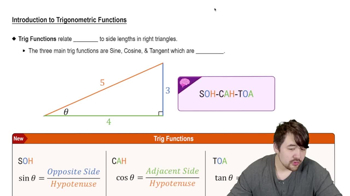
Trigonometric functions, such as sine and cosine, are fundamental periodic functions that describe relationships between angles and sides in triangles. They are essential for modeling oscillatory behavior and are defined on the unit circle. Understanding their properties, such as amplitude, period, and phase shift, is crucial for graphing and transforming these functions.
추천 영상:
가이드 코스
6:04
Introduction to Trigonometric Functions

Transformations of Functions

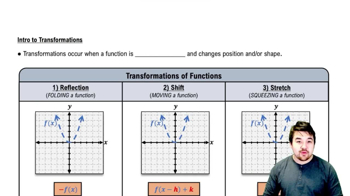
Transformations of functions involve shifting, stretching, compressing, or reflecting the graph of a function. For trigonometric functions, vertical shifts (adding or subtracting a constant) and horizontal shifts (changing the input variable) are common. These transformations allow us to manipulate the basic sine and cosine graphs to create new functions, such as the one given in the question.
추천 영상:
가이드 코스
5:25
Intro to Transformations

Graphing Utilities

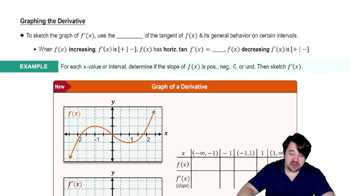
Graphing utilities are tools, often software or calculators, that allow users to visualize mathematical functions and their transformations. They can plot complex functions, helping to verify manual calculations and understand the behavior of functions over a range of values. Using a graphing utility is particularly useful for checking the accuracy of sketches and understanding the effects of transformations on the graph.
추천 영상:
가이드 코스
06:15
Graphing The Derivative
관련 실천
교과서 질문

Design a sine function with the given properties.

It has a period of 1212 with a minimum value of 4-4 at t=0t=0 and a maximum value of 44 at t=6t=6.

337
views
교과서 질문

Daylight function for 40 °N Verify that the function D(t)=2.8sin(2π365(t81))+12D(t)=2.8\(\sin\)(\(\frac{2\pi}{365}\)(t-81))+12 has the following properties, where t is measured in days and D is the number of hours between sunrise and sunset.


Its maximum and minimum values are 14.8 and 9.2, respectively, which occur approximately at t=172t= 172  and t=355t = 355, respectively (corresponding to the solstices).

527
views
교과서 질문

Area of a circular sector Prove that the area of a sector of a circle of radius r associated with a central angle θ\(\theta\) (measured in radians) is A=12r2θA=\(\frac\)12r^2\(\theta\).

<IMAGE>

460
views
교과서 질문

{Use of Tech} Triple intersection Graph the functions f(x) = x³,g(x)=3^x, and h(x)=x^x and find their common intersection point (exactly).

368
views
교과서 질문

Identify the amplitude and period of the following functions.

q(x)=3.6cos(πx24)q\(\left\)(x\(\right\))=3.6\(\cos\[\left\)(\(\frac{\pi x}{24}\]\right\))

307
views
교과서 질문

Daylight function for 40 °N Verify that the function D(t)=2.8sin(2π365(t81))+12D(t)=2.8\(\sin\)(\(\frac{2\pi}{365}\)(t-81))+12 has the following properties, where t is measured in days and D is the number of hours between sunrise and sunset. It has a period of 365 days.

626
views