Ch. 1 - Functions
Briggs - Calculus: Early Transcendentals 3rd Edition
Briggs3rd EditionCalculus: Early TranscendentalsISBN: 9780136847243당신이 사용하는 게 아니라요?교과서 변경
1장, 문제 40d

The graph of ƒ is shown in the figure. Graph the following functions. <IMAGE>


f(2(x1))f(2(x - 1))

검증된 단계별 안내
1
Identify the transformations applied to the function \( f(x) \). The expression \( f(2(x - 1)) \) involves a horizontal scaling and a horizontal shift.
Recognize that \( 2(x - 1) \) indicates a horizontal compression by a factor of \( \frac{1}{2} \). This means the graph will be compressed towards the y-axis.
The term \( (x - 1) \) represents a horizontal shift to the right by 1 unit. This means every point on the graph of \( f(x) \) will move 1 unit to the right.
Combine the transformations: First, shift the graph of \( f(x) \) 1 unit to the right, then apply the horizontal compression by a factor of \( \frac{1}{2} \).
Sketch the transformed graph by applying these transformations to key points on the original graph of \( f(x) \).

비슷한 문제에 대한 검증된 영상 답변:

이 영상 해법은 위 문제에 도움이 된다고 튜터들이 추천한 것입니다.
영상 길이:
4m
도움이 되었나요?

주요 개념

질문에 올바르게 답하기 위해 반드시 이해해야 하는 핵심 개념들은 다음과 같습니다.

Function Transformation

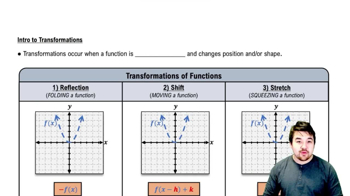
Function transformation refers to the changes made to the graph of a function based on modifications to its equation. Common transformations include vertical and horizontal shifts, stretches, and reflections. For example, the expression f(2(x - 1)) indicates a horizontal shift to the right by 1 unit and a horizontal compression by a factor of 2.
추천 영상:
가이드 코스
5:25
Intro to Transformations

Horizontal Stretch and Compression

Horizontal stretch and compression involve altering the width of the graph of a function. A factor greater than 1 compresses the graph, making it narrower, while a factor between 0 and 1 stretches it, making it wider. In the function f(2(x - 1)), the '2' compresses the graph horizontally, affecting how quickly the function values change as x varies.
추천 영상:
가이드 코스
5:25
Intro to Transformations

Graphing Composite Functions

Graphing composite functions involves plotting the output of one function as the input to another. In this case, f(2(x - 1)) means we first apply the transformation to x, then evaluate the function f at that transformed value. Understanding how to graph composite functions is essential for visualizing the effects of transformations on the original function's graph.
추천 영상:
3:48
Evaluate Composite Functions - Special Cases