
Ch. 10 - Sequences and Infinite Series
Briggs - Calculus: Early Transcendentals 3rd Edition
Briggs3rd EditionCalculus: Early TranscendentalsISBN: 9780136847243당신이 사용하는 게 아니라요?교과서 변경
10장, 문제 10.8.83

11–86. Applying convergence tests Determine whether the following series converge. Justify your answers.
∑ (from j = 2 to ∞)1 / (j ln¹⁰j)

검증된 단계별 안내
1
Identify the series given: \( \sum_{j=2}^{\infty} \frac{1}{j (\ln j)^{10}} \). This is a positive term series, so we can consider convergence tests suitable for positive series.
Recognize that the series resembles a p-series with an additional logarithmic factor in the denominator. Since \( j \) grows linearly and \( (\ln j)^{10} \) grows slower than any power of \( j \), we should consider the Integral Test for convergence.
Set up the Integral Test by considering the integral \( \int_{2}^{\infty} \frac{1}{x (\ln x)^{10}} \, dx \). If this improper integral converges, then the series converges; if it diverges, the series diverges.
Make the substitution \( u = \ln x \), which implies \( du = \frac{1}{x} dx \). This transforms the integral into \( \int_{\ln 2}^{\infty} \frac{1}{u^{10}} \, du \).
Evaluate the integral \( \int_{\ln 2}^{\infty} u^{-10} \, du \). Since this is an integral of a power function \( u^{-p} \) with \( p = 10 > 1 \), it converges. Therefore, by the Integral Test, the original series converges.

비슷한 문제에 대한 검증된 영상 답변:

이 영상 해법은 위 문제에 도움이 된다고 튜터들이 추천한 것입니다.
영상 길이:
8m
도움이 되었나요?

주요 개념

질문에 올바르게 답하기 위해 반드시 이해해야 하는 핵심 개념들은 다음과 같습니다.

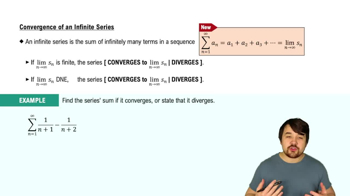
Convergence of Infinite Series

An infinite series converges if the sequence of its partial sums approaches a finite limit. Understanding convergence is essential to determine whether the sum of infinitely many terms results in a finite value or diverges to infinity or oscillates.
추천 영상:
가이드 코스
06:52
Convergence of an Infinite Series

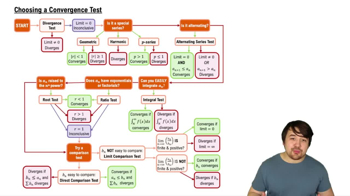
Integral Test for Convergence

The integral test compares a series to an improper integral of a related function. If the integral of f(x) from some point to infinity converges, then the series ∑f(n) also converges, and vice versa. This test is especially useful for series with positive, decreasing terms.
추천 영상:
가이드 코스
07:51
Choosing a Convergence Test

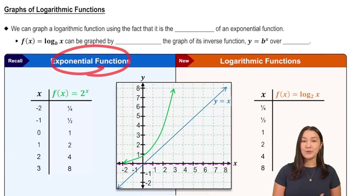
Behavior of Logarithmic Functions in Series

Logarithmic functions grow slowly, and their powers affect convergence rates. In series like ∑ 1/(j (ln j)^p), the exponent p determines convergence: the series converges if p > 1 and diverges if p ≤ 1, highlighting the importance of understanding how logarithmic terms influence series behavior.
추천 영상:
5:26
Graphs of Logarithmic Functions