Ch. 10 - Sequences and Infinite Series
Briggs - Calculus: Early Transcendentals 3rd Edition
Briggs3rd EditionCalculus: Early TranscendentalsISBN: 9780136847243당신이 사용하는 게 아니라요?교과서 변경
10장, 문제 10.1.31a

27–34. Working with sequences Several terms of a sequence {aₙ}ₙ₌₁∞ are given.
a. Find the next two terms of the sequence.


{1, 3, 9, 27, 81, ......}

검증된 단계별 안내
1
Identify the pattern in the given sequence: {1, 3, 9, 27, 81, ......}. Notice how each term relates to the previous term.
Check if the sequence is geometric by dividing each term by the previous term. For example, calculate \( \frac{3}{1} \), \( \frac{9}{3} \), \( \frac{27}{9} \), and \( \frac{81}{27} \).
If the ratio between consecutive terms is constant, denote this common ratio as \( r \). This means the sequence is geometric and each term can be expressed as \( a_n = a_1 \times r^{n-1} \).
Use the common ratio \( r \) to find the next two terms by multiplying the last known term by \( r \) to get the next term, and then multiply that result by \( r \) again to get the term after that.
Write the expressions for the next two terms as \( a_6 = a_5 \times r \) and \( a_7 = a_6 \times r \), substituting the known values to express these terms explicitly.

비슷한 문제에 대한 검증된 영상 답변:

이 영상 해법은 위 문제에 도움이 된다고 튜터들이 추천한 것입니다.
영상 길이:
1m
도움이 되었나요?

주요 개념

질문에 올바르게 답하기 위해 반드시 이해해야 하는 핵심 개념들은 다음과 같습니다.

Sequences and Terms

A sequence is an ordered list of numbers following a specific pattern. Each number in the sequence is called a term, typically denoted as aₙ, where n indicates the term's position. Understanding how terms relate helps predict future terms.
추천 영상:
8:22
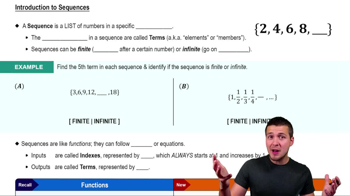
Introduction to Sequences

Geometric Sequences

A geometric sequence is one where each term is found by multiplying the previous term by a constant ratio. Identifying this ratio allows you to generate subsequent terms by repeated multiplication.
추천 영상:
04:18
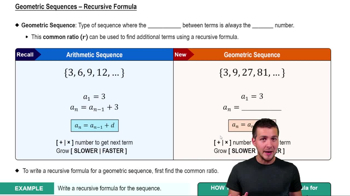
Geometric Sequences - Recursive Formula

Pattern Recognition and Prediction

Recognizing the pattern in a sequence is essential to find missing or future terms. This involves analyzing the given terms, determining the rule (such as addition or multiplication), and applying it to extend the sequence.
추천 영상:
가이드 코스
03:05
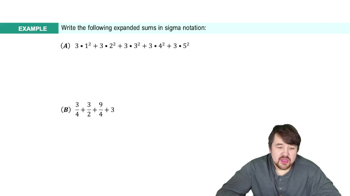
Sigma Notation Example 1
관련 실천
교과서 질문

57–60. Heights of bouncing balls A ball is thrown upward to a height of hₒ meters. After each bounce, the ball rebounds to a fraction r of its previous height. Let hₙ be the height after the nth bounce. Consider the following values of hₒ and r.


a. Find the first four terms of the sequence of heights {hₙ}.


h₀ = 30,r = 0.25

54
views
교과서 질문

Explain why or why not

Determine whether the following statements are true and give an explanation or counterexample.

a. If the Limit Comparison Test can be applied successfully to a given series with a certain comparison series, the Comparison Test also works with the same comparison series.

46
views
교과서 질문

87. Explain why or why not

Determine whether the following statements are true and give an explanation or counterexample.


a. If ∑ (k = 1 to ∞) aₖ converges, then ∑ (k = 10 to ∞) aₖ converges.

47
views
교과서 질문

{Use of Tech} Drug Dosing

A patient takes 75 mg of a medication every 12 hours; 60% of the medication in the blood is eliminated every 12 hours.


a.Let dₙ equal the amount of medication (in mg) in the bloodstream after n doses, where d₁ = 75.

Find a recurrence relation for dₙ.

44
views
교과서 질문

Explain why or why not Determine whether the following statements are true and give an explanation or counterexample.


a. n!n! = (2n)! for all positive integers n.

59
views
교과서 질문

{Use of Tech} Repeated square roots

Consider the sequence defined by

aₙ₊₁ = √(2 + aₙ),a₀ = √2, for n = 0, 1, 2, 3, …


a.Evaluate the first four terms of the sequence {aₙ}.

State the exact values first, and then the approximate values.

38
views