Ch. 10 - Sequences and Infinite Series
Briggs - Calculus: Early Transcendentals 3rd Edition
Briggs3rd EditionCalculus: Early TranscendentalsISBN: 9780136847243당신이 사용하는 게 아니라요?교과서 변경
10장, 문제 10.2.95a

{Use of Tech} Repeated square roots
Consider the sequence defined by
aₙ₊₁ = √(2 + aₙ),a₀ = √2, for n = 0, 1, 2, 3, …


a.Evaluate the first four terms of the sequence {aₙ}.
State the exact values first, and then the approximate values.

검증된 단계별 안내
1
Start with the initial term given: \(a_0 = \sqrt{2}\). This is your starting point for the sequence.
Use the recursive formula \(a_{n+1} = \sqrt{2 + a_n}\) to find the next terms. For \(a_1\), substitute \(a_0\) into the formula: \(a_1 = \sqrt{2 + a_0}\).
Calculate \(a_2\) by substituting \(a_1\) into the formula: \(a_2 = \sqrt{2 + a_1}\). Keep the expression exact without approximating yet.
Similarly, find \(a_3\) by substituting \(a_2\) into the formula: \(a_3 = \sqrt{2 + a_2}\). Again, keep the exact form.
After writing down the exact expressions for \(a_0\), \(a_1\), \(a_2\), and \(a_3\), approximate each value using a calculator or technology to get decimal approximations.

비슷한 문제에 대한 검증된 영상 답변:

이 영상 해법은 위 문제에 도움이 된다고 튜터들이 추천한 것입니다.
영상 길이:
2m
도움이 되었나요?

주요 개념

질문에 올바르게 답하기 위해 반드시 이해해야 하는 핵심 개념들은 다음과 같습니다.

Recursive Sequences

A recursive sequence is defined by specifying one or more initial terms and a rule to find each subsequent term from the previous ones. In this problem, each term aₙ₊₁ depends on the previous term aₙ through the formula aₙ₊₁ = √(2 + aₙ). Understanding recursion helps in computing terms step-by-step.
추천 영상:
6:40
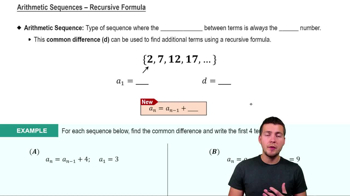
Arithmetic Sequences - Recursive Formula

Square Roots and Nested Radicals

Square roots involve finding a number which, when squared, returns the original value. Nested radicals, like √(2 + √(2 + ...)), appear in this sequence. Recognizing how to simplify or approximate these expressions is key to evaluating terms exactly and approximately.
추천 영상:

Exact vs. Approximate Values

Exact values are expressed in precise mathematical form (e.g., √2), while approximate values are numerical estimates (e.g., 1.414). Calculating both helps understand the behavior of the sequence and provides insight into convergence or growth patterns.
추천 영상:
가이드 코스
04:25
Average Value of a Function Example 1
관련 실천
교과서 질문

88–89. Binary numbers

Humans use the ten digits 0 through 9 to form base-10 or decimal numbers, whereas computers calculate and store numbers internally as binary numbers—numbers consisting entirely of 0’s and 1’s. For this exercise, we consider binary numbers that have the form 0.b₁b₂b₃⋯, where each of the digits b₁, b₂, b₃, ⋯ is either 0 or 1. The base-10 representation of the binary number 0.b₁b₂b₃⋯ is the infinite series

b₁ / 2¹ + b₂ / 2² + b₃ / 2³ + ⋯


89. Computers can store only a finite number of digits and therefore numbers with nonterminating digits must be rounded or truncated before they can be used and stored by a computer.


a. Find the base-10 representation of the binary number 0.001̅1.

70
views
교과서 질문

Explain why or why not

Determine whether the following statements are true and give an explanation or counterexample.

a.If limₙ→∞aₙ = 1 and limₙ→∞bₙ = 3, then limₙ→∞(bₙ / aₙ) = 3.

48
views
교과서 질문

Explain why or why not Determine whether the following statements are true and give an explanation or counterexample.


a. The sum ∑ (k = 1 to ∞) 1 / 3ᵏ is a p-series.

56
views
교과서 질문

87. Explain why or why not

Determine whether the following statements are true and give an explanation or counterexample.


a. If ∑ (k = 1 to ∞) aₖ converges, then ∑ (k = 10 to ∞) aₖ converges.

47
views
교과서 질문

27–34. Working with sequences Several terms of a sequence {aₙ}ₙ₌₁∞ are given.

a. Find the next two terms of the sequence.


{1, 3, 9, 27, 81, ......}

48
views
교과서 질문

Explain why or why not Determine whether the following statements are true and give an explanation or counterexample.


a. n!n! = (2n)! for all positive integers n.

59
views